Showing posts with label North Korea. Show all posts

Wednesday, April 26, 2017

So long mom, I'm off to drop the bomb....


Tom Lehrer - A man who was way ahead of his time in many ways. I only wish he would (and could) write and perform some new tunes for today's absurd reality. But I can't stop thinking of his song written in advance for World War 3: "So long mom (A song for World War 3)."

North Korea is taking advantage of the weakness it sees in the West to become even more belligerent. Trump is the critical weak point in the West's resolve to keep the peace, a peace which allows South Korea to prosper. And I can only see war in the future, with the likely possibility that nuclear weapons will be used as they may be the only tools which will stop North Korea from becoming a threat to the entire Western world.

- - - - - -

The problem dates back to the 1950's, when China decided to fight with North Korea against America and its allies to keep the American forces from coming too close to their border. China got stuck with protecting the Kim family's dysfunctional regime. We were at the beginning of the Cold War with Communist states, and the fighting in Korea was an anomaly. The Kims saw that they could become miniature emperors as long as they tied their wagons to Communist horses.

After almost 70 years since the uneasy peace was declared, the Kim family is still in power. They have used an elegant form of ransom to extract money from the West - holding Seoul as an effective hostage. Since South Korea has become a wealthy nation, the West would lose even more wealth if war were to break out again. So it decided to pay the ransom and kick the can down the road to future leaders to deal with. This was a big mistake.

The Kims made a big mistake too. They decided on building both ICMS and nuclear weapons, with the goal of being able to hold any nation on the planet hostage to their aims. The USA can not afford to lose any of its major cities. (Insert cynical joke here, based on your politics.) So we will likely be forced to act, even though the West will lose South Korea's economy and wealth in the process.

Strangely, as much as I hate Trump the man, I'm glad that he will let the military make the decisions needed to fight North Korea when the time comes. The military knows he is not competent enough to make decisions required of a commander in chief. So they will act responsibly, but give him enough cover to look presidential.

But what happens after the war? Ay, there's the rub. In order to limit the damage, South Korea will need to be protected from reunification. Since the North Korean people have been brainwashed to worship the Kim family, it will be a great effort and risk to absorb this useless population into a South Korea that will be trying to rebuild a country after a major war. They will want (but never saying this) as many primates as possible exterminated between the DMZ and the Yalu river (the Chinese Border). This means that South Korea has an interest in America to test and use as many of its military toys as possible in that war. And our military will only be too glad to oblige.,

Am I being overly cynical and pessimistic? Maybe. But I haven't thought of any other possible solution that could occur with less bloodshed and suffering....

Wednesday, March 1, 2017

I'm not sure about to write about this week


- - - - - -

The "Gray Lady", as the New York Times is often called, had a lot to report on the day I wrote this post.  And I was unsure about what was the most important thing out there.  Was it the resignation of Michael Flynn, after less than a month into Trump's regime? Was it Trump's statement that Israel need not pursue a "two state" solution with the Palestinians? Was it the revelation that senior Trump assistants were in constant contact with Russia during his campaign?  Was if the assassination of Kim Jong Un's half brother in Malaysia? Was it the revelation that Russia broke one of the nuclear anti-proliferation treaties, by testing a new type of missile? Or, was it the revelation that the American intelligence agencies no longer trust Trump or his staff to keep America's secrets secret, and are now withholding information from the president?  Any one of these things could be major news items in their own right.  But all of these things happening at once has gotten me worried.

- - - - - -

Our current president is as inept as he is corrupt.  Couple this with a GOP that is ethically bankrupt, and wants power over doing things for the public at large, and we are in serious trouble. One Republican that I once respected, Rand Paul, has just lost any support I might have given him.  He would prefer to dismantle the ACA (Obamacare) than to determine how close a relationship the Trump Campaign had with the Russians.  Paul believes that no Republican should be investigating other Republicans.  Paul Krugman notes that the GOP would rather choose treason to give tax cuts to the wealthy, as corruption is endemic to the GOP. Whether I'd go this far, I don't know.  But it seems as if the GOP wants power for power's sake, and not to exercise it wisely.

I am concerned about giving Netanyahu options NOT to pursue a two state solution in Israel/Palestine. This region is dangerous enough now.  Why give extremists any more fuel to add to the fire?  Our previous Secretary of State noted that Israel could be either a Democracy or a Jewish State. But it could not be both if a two state solution is not pursued. If we support Netanyahu's actions, we may just light the fire of the next Middle Eastern war without realizing it.

- - - - - - 

Often, what North Korea does is an interesting side show to the world.  They tend to make bellicose statements, but can't do much to cause trouble elsewhere.  Yes, they have forged $100 bills so perfect that the Federal Reserve told US banks to honor the "funny money" until they had a reliable way to detect the bogus bills. Yes, they have hacked into many computer systems, and caused organizations such as Sony Pictures much grief. But now, they have started to assassinate people outside their borders.  Can this be tolerated? Yes, the fellow who was poisoned was the half brother of the "supreme leader". But who might be killed next?

- - - - - -

Russia has tested a new cruise missile that the US says violates previously signed treaties. Would this have taken place had Hillary Clinton been in office?  I doubt it.  With Trump in office, Putin can do no wrong. Now that US intelligence agencies no longer trust the president to keep secrets, I wonder what comes next.  

These are scary times, and I don't trust our leaders to do the right things, nor do I trust the system of checks and balances to work in the presence of this much corruption in the system.  I could be wrong.  But when Joe Scarborough started worrying about the White House and its lack of respect for the Judiciary, we should see this as the canary in the coal mine alerting us to big problems ahead.  No president should have unchecked powers, and Joe makes this clear after reviewing Steven Miller's comments on the power of POTUS.


Wednesday, April 6, 2016

Cuba Libre... More than just a drink.


The Cuba Libre - a drink that has both political and social meanings.  

As I write this, President Obama is about to visit Cuba - the first American President to visit in approximately 90 years.  Much has changed in both countries, and in the drink since then, As a result, many angry words have separated these two countries - countries that should have been friends for most of the past 60 years.

One can not say for sure that the original drink was made with Coca Cola according to the linked article.  But by the 1940's, a Rum and Coke was what was understood to be a Cuba Libre.  During this time, Ernest Hemingway was becoming a native of both Florida and Cuba, being well known for being a patron of El Floridita Fast forward a few years, and we have the Cuban Revolution - where Castro threw out the corrupt Batista regime (as well as the American mob), and sided with the Soviets in the time of the Cold War.  As a result, the American public became brainwashed to see Cuba as an enemy nation.

During the early stages of Castro's rule, he nationalized virtually all of Cuba's industry, and did not compensate their owners (mostly American) for the taking of their property. (Bacardi's holdings were affected.  Luckily, they had enough resources to relocate their brand and production to Puerto Rico.) A large wave of people fled Cuba, coming to the US, and many of them settled in Florida - distorting the politics of the state for generations to come. Not only did we have an important group of business leaders who had a bug up their collective ass regarding Cuba, but we had a vocal group of people making sure that we couldn't easily make peace with the Castro regime.

Let's look at some complications that caused us problems: 

  1. Bay of Pigs fiasco
  2. Cuban Missile Crisis
  3. Cuban Trade Embargo
  4. Kennedy Assassination
Each issue on its own wouldn't be that bad.  But when the net effect of all of them are put together, it's easy to see how we'd be unable to have official relationships between our countries for 50+ years.  The Bay of Pigs fiasco made it possible for Castro to use his revolution as a potent symbol to encourage support for his regime against the will of the USA. The Cuban Missile Crisis allowed the US and USSR to deescalate tensions, preventing a war (that Castro wanted). The Cuban Embargo which prevented commerce between the two nations didn't help but to further separate the two nations from each other. Most people don't know this, but Kennedy was working on ways to get rid of the embargo before he was killed. Sadly, the one person who could have reversed this pattern of animosity between nations wasn't around to fix things - and as a result, we had an extra 50+ years of separation.

It's amazing how much flak Obama received for starting the process of normalizing relations between our two countries.  Unlike North Korea, Cuba has not developed nuclear weapons, nor has it developed intercontinental ballistic missiles.  Yet, until recently, I could legally spend money in the DPRK, and not in Cuba.  This is ludicrous!  I'm glad that I'm seeing positive changes occur in my lifetime....

But I will close out with a thought I had about 20 years ago, and wish I could have made true.  When my dad was cleaning out my grandmother's apartment, he found a bottle of Bacardi Rum that was labeled "Product of Cuba".  (I wish I could have saved that bottle and its contents.)  A few years later, the CEO of Coca Cola was a Cuban emigre. A couple of my co-workers were Cuban exiles.  A perfect thing to do would have been to bring in this bottle of rum, have a fresh bottle of Coke near my desk, and bring these two men over on New Years Eve to wish them a Happy New Year, and a free Cuba, all with true Cuba Libres in our hands.....


Wednesday, January 20, 2016

Thoughts about dismantling the Military-Industrial Complex


When I first planned to write this week's entry, my original topic choice was Saudi Arabia's decision to cut diplomatic ties with Iran following riots sparked by the Saudi execution of a Shiite cleric. (This may be covered in a future entry.)  While reading the Sunday newspaper, a better topic came to mind: the economics of dismantling part of the US Military-Industrial complex.

- - - - - -

In a recent NY Times opinion page article, the author discusses how the Death Star may have been a project that was too big to fail, and how the rebellion may not have been well received because of the economic chaos that ensued after its destruction.  Given how much of our economy depends on the military to keep it afloat, do we suffer from the same problem that the fictional galactic empire may have suffered with?

Let's say that we use a reported figure of $718,000,000,000 for current US Military spending and attempt to cut that in half, and spend $359,000,000,000 on domestic projects such as rebuilding our roads, providing health care, educating people and shoring up Social Security.  What would happen if the budget were cut quickly, without a proper transition?

First, what would happen to the displaced top secret technology workers?  How would they find employment?  What fields would they work in?  This is not a spurious question.  The US had to address this concern at the end of the Cold War. Yet, our "defense" spending is higher than ever. The USSR had even greater problems, as it lost the Cold War and had no plan to reintegrate the displaced workers into a civilian economy.  In fact, the "West" was more than willing to pay displaced Soviet scientists NOT to sell their services to a rogue country.  Can you imagine what costs would exist for transitioning some of these workers to the civilian economy?

Next, America operates in a much more transparent economic environment than most countries. How would we use the newly freed funds? (Approximately $1,200 per US Citizen.)  In theory, that could pay much of the cost for giving every citizen subsidized health insurance.  But that money would be just as needed for education, infrastructure renewal, etc....  How would the funds be divided?  And if an equitable division could be arranged, then where would we get the new, trained, skilled workers? It might make sense to do a gradual transition, if only to train the workers we need in the fields we plan to staff with new workers.

- - - - - -

We must preserve our old skill sets.  Although we do not need to build new B-52 bombers, they must be maintained.  (Note: Planned replacements for these old workhorses have been built, but still do not have the ruggedness of this "ancient" plane.  We may actually need to build replacements, albeit fitted with modern technology at some point in the future.)  But, how do we preserve the skills to make nuclear weapons?  What about germ and chemical warfare? We can't afford to be blind sided by some rogue state that decides to use these weapons - we must know how to deploy them and to defend ourselves against them.  Moving forward is a bitch.  But forgetting the lessons of our past is even worse.  It saddened me when many Americans looked at China's putting a man in space as old news - a "been there, done that" attitude.  They are doing it with NEW technology.  We have forgotten how to do it with OLD technology. And the workers who built that technology for us are dying off without proper replacements....

So we need to keep part of the Military-Industrial complex in place, no matter what peace advocates want. The only to have peace (and I cite Sun Tsu) is to be prepared for war well enough so that others will avoid battle with you.  How might this peace be obtained? 

First, we need to get the Military-Industrial complex into making civilian goods again.  Instead of making limited use "Mil-Spec" electronics, they should develop trusted civilian sources for ruggedized technology - and use that for new military uses.  Instead of using 30 year old chip design, make sure that backward compatible design (with both hardware and software) be incorporated into all Military electronics, so that upgrades can be cost effective. However, this is only one area of improvement.  We must resist the idea of over designing products.  Yes, we want to keep our troops safe. But are $350,000,000 fighter jets the answer, when cheaper solutions can be found?  Why should fighter jets be all-purpose? There is no good reason that the Air Force and Navy must have compatible jets - they just need to have as many interchangeable "off the shelf" parts as humanly possible, so that customization for each service can be done as cheaply as possible.

Next, we must provide for the threats of the 21st century.  And many of them will be electronic.  We need to protect our businesses from foreign hacking, and we do a piss poor job of that.  Luckily, our businesses do a better job (from what I can tell) protecting themselves than our government does. Heck, when North Korea has the implicit protection/cooperation of China to hack our systems, then we have problems.  (See: Bureau 121 - Shenyang China.) What is our government doing to protect us?  Not that much - it is focused on keeping the old military technology alive.  If we are to make this transition, we also need to provide more profitable opportunities for businesses in the Military-Industrial complex, and this is an area that will help American civilians and the profits of the Military-Industrial complex.

- - - - - -

Hopefully, whoever we elect on Election Day 2016 will be wise enough to see this opportunity to make America strong again.  We no longer need to be "Great".  But we do need to take care of our own needs as a society, and not just the needs of one sector of that society....


Wednesday, October 28, 2015

Chaos in the house


From what I understand, our forefathers thought that the Speaker of the House of Representatives would be America's most important political position, and not the office of the President.  However, it is the presidency which has become the most important office - and for good reason. As Harry Truman said: "The Buck Stops Here!"

Lately, no sane man would consider the position of Speaker of the House.  Rep. Boehner resigned, as he felt that he couldn't control the extremists in his party and get them to vote on "must pass" bills needed to keep the government running. He was tired of the responsibilities of the office, and decided to retire instead of destroying himself by staying in the battle. But this left Rep. McCarthy next in line for the office.

There are many reasons why McCarthy should not be Speaker of the House. But I won't go into the ones that many Democrats might bring up.  Instead, I'll trust his judgement that he is not the right man for the job, and speculate that he did not want to take the blame for a likely government shutdown (which would likely happen by the time this entry is made public). He's smart enough to know that the same angry people who are propelling Trump's candidacy are also the same people who no longer trust political insiders to do anything to address their concerns.  They feel they have nothing to gain by keeping the present elite in charge, so they are willing to collapse the system to make their voices heard.

But what does this mean for our "democracy"?  

If the House was designed as a place where the people could vent their feelings, and the Senate was a place to prevent short term feelings from mucking up the system, then what happens when the legislative branch is dominated by a party which is unable to govern? To me, this forces a president (most likely from the opposing party) to govern by edict and by novel interpretations of existing law.  This is very dangerous, as power keeps shifting from the legislative branch to the executive branch - and this power is subject to fewer checks and balances as time goes on.

Eventually, one party will control the two elected branches of government.  And if the party is as dysfunctional as today's GOP, then I have serious concerns. The angry mob that is disrupting the functions of the House could gain control of the executive branch - and that could be the end of the republic.

Why such a concern?

Let's take an inflammatory issue such as abortion.  Many scholars thought that Roe vs. Wade was a horrible decision - not because of which side won, but because it forced society to adapt too quickly to change.  Later rulings have softened the blow, and have rolled things back a bit.  But they (SCOTUS) have always relied on judicial precedent to guide them in new rulings.  What would happen if a new, replacement elite were to ignore precedents? The loss of abortion rights in themselves might not be that onerous. But could you imagine possible government intrusion in a woman's reproduction to make sure that all fetuses are tracked and accounted for?  

Long term government policies that cross administrations could also be overturned at a whim.  Could you imagine the lunacy of a rapid rapprochement with North Korea?  Heck, Cuba and Iran have never been as much trouble to the US as the DPRK has been, and yet they get all the press these days because of a slow and careful movement towards normalization with these countries.  Would we kill NAFTA without serious thought? Possibly. But this is why our government was designed to implement change slowly - so that we don't make the mistakes often made when the voice of the mob drowns out the voice of reason.

But what role should an elite play?

This question has been central to American polity since the days of Jefferson and Hamilton. As for me, like Hamilton, I believe that there is a natural elite that tends to form in any society. But like Jefferson, I also believe that to be free, "the tree of liberty must occasionally be watered with the blood of tyrants."  America has been a stable republic because its design provides for a greater tolerance of instability in the system.  I only hope that the design keeps working - and I'm not too sure of this any longer....


Wednesday, April 1, 2015

Hypocrisy and Bias in Media


Gone are the days where we could trust our newscasters to provide us with a version of the news biased towards the middle of the road. We as a nation may not have been objective, but we trusted our newscasters to be so - even when the news didn't agree with our political views. Today, we have "Narrow-casted" news, where cable channels broadcast to narrow market segments, feeding them the pablum they want to hear, and interpreted through the lenses of people who agree with them - never challenging the viewer to look at the world through a different perspective.

Recently, Brian Williams has been in the news for not being truthful in his news reports. Supposedly, he will be out for 6 months - until things cool down - but I'm not sure if he'll be back for long. I don't think people like him are the real problem in news. Instead, the problem is the firms that encourage excessive bias in the news. 

Years ago, I learned a simple fact. If a country had to use "Democratic" in its official name, the odds were that the country had an authoritarian regime. A good example of this is the DPRK - Democratic People's Republic of Korea. I don't believe that anyone outside North Korea believes that the Kim family really cares for its subjects. But I digress. The same idea also applies for news outlets. If an outlet claims to be "Fair and Balanced", the odds are that it is Unfair and Biased. I am very wary of claims from both the left and the right - both tribes are led by opportunist conspirators, and will cloak themselves in the garb of caring for the little fellow.

Why is it that MSNBC ignores Al Sharpton's past? Even though he might be a reformed man now, he still strikes me as an opportunist who works on a more subtle level than when he was younger. And why has Fox News ignored the lies coming from its own editorial staff? If one of its big shows claims to be a "No Spin Zone", why did a high school have to take his show to task for violating journalistic ethics? It seems like both sets of talking heads get their marching orders, and ignore the indiscretions of their own teams in order to sell their agendas to the unthinking public.

One of my friends believes in every conspiracy theory that comes her way. Most have been proven false. However some might be true - but not in the way she understands the world. The way I look at it, 99.44% of us are effectively pawns in the games of the rich and powerful. There are many power blocs among the elite, and they conspire against each other for greater power. Some of them believe in over population (which results in lower wages and fear of job loss), as this is an easy way for this elite to maintain positions of power. Other groups within the elite believe that greater wealth and power can be gained by fulfilling the wishes and needs of the other 99.44%. And still others benefit from dividing the 99.44% against each other. It is plausible that blocs within the elites conspire against each other, and we are affected, being mere pawns in the game.

I attempt to see reality by skipping over the BS being spewed by the two major factions in our society, and by reading media from sources (often overseas) who have less skin in the games being played in America. I compare their reporting against what is being said in America to develop a better idea of what the truth might be, and test that idea against the objective facts as I know them. And so far, luckily, I have been on target more than I would have been otherwise. Is the media biased? Yes. Are the spinmeisters hypocritical? Of course. But that doesn't make it impossible to see the truth - if one is willing to let one's own prejudices drop by the wayside....


Wednesday, March 4, 2015

It's not just what you know, but how and when you use that knowledge.


Not many people have seen an Enigma machine close up - but I have. It's an amazing piece of engineering, but not as amazing as the fact that we cracked the code AND knew enough not to use all the knowledge we had, lest we clue the enemy in to the fact that their codes were broken.


- - - - - -

During WW2, one of the biggest clandestine goals of British intelligence was to break the German Enigma codes. Every day, the Germans would change the rotors and give the Enigmas new settings to code and decode messages. The Allied forces could not break these codes until Alan Turing figured out the weaknesses of what the Germans were doing. 

After the codes were broken, what next? One had a good idea of what the enemy knew, but could they prevent disasters? Often, NO! Unless there was a plausible way to explain why a troop movement was changed, why a convoy was rerouted, why some action was not taken, the Allies had to accept the known attack to come.

Today, we are in a similar war - but against many powers. Ars Technica describes what one division of the NSA is likely to have done in infecting systems around the world, so that America has a technical edge which might be used militarily.  

- - - - - -

In the past, America has tapped Soviet (now Russian) cables connecting the mainland to Vladivostok to keep tabs on the fleet stationed there. But the Soviets were able to plant a bug in the American Embassy in Moscow - inside the Great Seal given to us as a gift. And the Chinese are known to have their electronic spies as well. All the major nations are playing this game, and they have likely evolved a form of "rules of engagement" for use when dealing with each other. But this doesn't apply to nations that aren't top tier powers. Nor does this apply to non-national powers, such as Palestine (not yet a nation) or ISIS.

As civilians, none of us (for all practical purposes) have any clue to what is going on behind the scenes. We do not know for sure how successful the STUXNET virus was in attacking Iran's Uranium enrichment program, but it likely set Iran back by a year or two. Even more interesting is North Korea's military programs - could they have been compromised by malware hidden in the hard drives they bought from outside the country? (I'd bet that China may playing a role here, as they have gotten weary of keeping this dysfunctional regime afloat.)

- - - - - -

Much of the time, information like this never makes it to the history books. Alan Turing's accomplishments were kept Top Secret by the British for a couple of generations. Once classified as Top Secret, few governments ever bother to reclassify information which no longer needs to be kept secret. Yet, some secrets are kept by hiding them in plain sight. Leon Theremin was reportedly kidnapped from the United States in the 1930's (there is information that says he left for tax reasons), and after a stint in the gulag, then working for the KGB, ended up at the Moscow Conservatory of music (building Theremins and other musical instruments) before becoming a professor of Physics at Moscow State University.

- - - - - -

There are people who want our president to go to war against ISIS, putting boots on the ground.  Are we ready to have our children come back from the war in body bags (or worse)? I doubt it. Years ago, President Kennedy contacted the pilots flying spy planes over Cuba and gave them orders (with explanations) to NOT report any hostile fire from the ground while flying their missions. Many planes came back perforated - and the pilots claimed they hit birds and other things. This gave the president the room he needed to talk peace. But it was not only an American who prevented the Third World War - there was a Soviet Officer, Vasili Arkhipov, who kept his submarine from launching nuclear missiles while the submarine he was on was being attacked by American depth charges. Hard Liners in both countries wanted war - thankfully, that war never happened. Are we ready for yet another "Forever War", because we're seeing extreme inhumanity from an enemy? Or, are there other things we can do (or are being done) that can limit the scope of the war?

Right now, we do not have all the facts, and we are being manipulated by the media. We have to watch out how the media is being manipulated - when the Jordanian pilot was burned to death, none of America's Left and Centrist media provided links to see this murder. Only the Right wing media provided links to view the murder, as it is trying to stir up the will for Americans to endure yet another war. In fact, politicians are already saying we should resort to nukes, and kill ruthlessly. Wouldn't it make more sense to get more information before another rush to war?


Thursday, January 1, 2015

Another year over, and a new one just begun.


As usual, no one knows what will happen at the beginning of the New Year. But we do know that the old year brought a lot of change. And this year was no different. There were many changes, and yet, the world remained much the same as it has always been - an orb where over 7 billion people repeatedly fight to make it through another day of life.

The New York Times Sunday Magazine has put out its usual memorial issue, where they commemorate the lives of those who have passed. And we are reminded of what we have lost, not knowing what we will gain in the years to come. There are many great people we have lost, some famous, and some who are not. But all have a commonality to them - they have made an impact on our lives.

We have seen the development of new enemies, as well as the neutralization of old ones. Who'd have thought that ISIS would be a major concern a couple of years ago? Who'd have thought that North Korea would attempt to threaten Americans if they watched a mediocre film that cast their leader as the focal point of bad humor? Who'd have thought that the USA would be working with Iran, and deescalating years of tension between the countries? And who'd have thought that the United States and Cuba would be normalizing political relations with each other?

Much of the news was controversial - not only because of its content, but for what it meant about the people being reported on. In the case of the Senate Report on Torture, we found that the CIA made a cascading series of moral mistakes after being charged with gaining information from GITMO prisoners, and then did whatever was in their political power to cover up their actions. Yes, the report was going to be political in nature - could anything coming out of Washington, DC not be political?  What saddens me most is that many Americans are so happy to use torture as a tool, forgetting that even our captives deserve to be treated as humans. in accordance with treaties signed by the United States.

But who could have foreseen the Pope chastising the Roman Curia? Of all 2014's events, this one seems the most amazing, as religious leaders have not sparked as much change as this Pope seems to have done. Without changing a letter of dogma, he has changed the focus of the message. Instead of rigid obedience and conformity, it is now one of forgiveness, tolerance and hope.

As they say, "the more things change, the more they stay the same." And this has been true about 2014. Hopefully, we'll see 2015 show more of the good side of humanity than 2014 did....


Saturday, December 20, 2014

Even Eric Cartman couldn't cause this much trouble


I'm disgusted!  An all but acknowledgement of state sponsored terrorism, and no way to deal with the criminals behind it. (And if there is a plan, our government is not talking about it.)

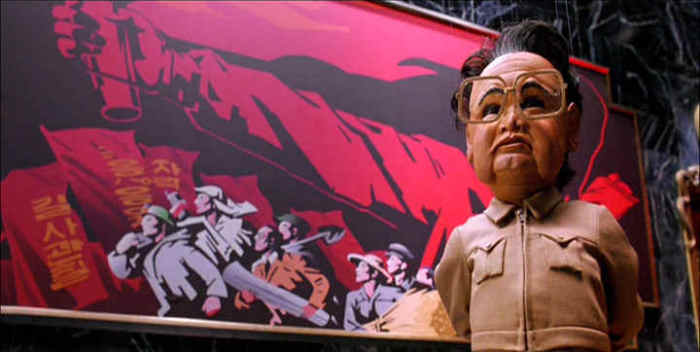
We have just seen our 1st amendment trumped by a terrorist threat to bomb movie theaters that show "The Interview" - a film about two people being recruited to assassinate the leader of North Korea. Sony's computers have been hacked, theater chains refuse to show the picture, and the public denied the right to see a movie previously scheduled to open on Christmas day. Even worse, when theaters decided to show "Team America, World Police" instead, Sony shot down their chances of showing this film as well.

I never thought we'd see our freedoms at risk this way - Americans are running scared because of a threat from some unnamed hackers. North Korea is a basket case of a country, and one that will eventually collapse if both China and the West stop bailing it out. Sadly, there are problems with this. The South Koreans can't afford to rescue the North, the Chinese don't want a reunification that puts a strong American ally on its borders, Russia has a veto in every possible situation, and the Americans have every reason to wait things out. So North Korea continues to exist, blackmailing the major players in the region for what the dictatorship needs to survive.

But what would happen if we looked at this situation as an opportunity?

There is an old saying: "They shoot horses, don't they?" And maybe this is how the Americans, Chinese and Russians should think about North Korea.  What would happen if all possible opposition were neutralized in the North, and the three major powers were to create a consortium for the extraction of rare earth minerals - raping the land (something already being done) for their profit, instead of that of the Kim regime?

Yes, I am talking about the destruction of a nation for profit. But I doubt that anything could save the North Korean people - at least not at the prices that any of the stake holders are willing to pay. But please remember that I pose this "modest proposal" only as a thought experiment, and one meant to change how people are thinking of the problem posed by North Korea.  There are millions of lives at stake. And eventually, someone will have to address their needs when North Korea self destructs....


Thursday, December 18, 2014

A long needed thaw - something I never thought I'd see....


This is what most Caribbean nations dependent on tourism feared - the United States and Cuba gradually warming up to each other. There are so many things which should be binding the two nations together, but for bad politics (on both sides) and an assassinated American President that got in the way of common sense.

One person told me that addiction is similar to having to choose between opening two doors. The first door will allow you to exit the room. The second door will have you beaten up by a gorilla. The addicted person keeps repeatedly choosing the second door, while the non-addict will quickly choose the first door and leave the room. When the addict is asked why he keeps choosing the same door, the addict will respond with something to the effect - well, it can eventually change, can't it?

Our policy towards Cuba has been very much like that of the person who keeps opening up the wrong door - the Castro regime has not been ousted, and it has become even more entrenched over the years. Many people want to punish Cuba for its actions of 53 years ago, but most people alive today weren't alive when the embargo was put in place. What good does punishing a country do when the people being punished are not responsible for the problem. This punishment seems to be a misguided approach to keeping the first generation of Cuban exiles happy and voting according to their current patterns.

Most people don't know that it is perfectly legal for Americans to visit North Korea, a country more troublesome to American interests, and spend money there. Yet, in a country that has not been shown to sponsor terrorism (save, in the figments of collective Washington, DC political imagination), it is effectively illegal for Americans to be there. Something is very wrong - and it likely has to do with American political paralysis.

There are issues that will need to be negotiated before a full thaw has occurred. And they have nothing to do with promoting democracy in Cuba. Instead, they will have to do with trademarks and the exports of certain goods. For example, Bacardi Rum got its start in Cuba. The family took the brand along with them when they left Cuba, and established it in Puerto Rico. Do you think they can afford to have the Cubans sell rum under the Bacardi name after the embargo is lifted? Another example is Cohiba cigars. The brand available in the USA is made in the Dominican Republic, while the brand available in most of the world is made in Cuba. How will this get resolved?

If anyone brings up the idea that Cuba stole property from its rightful owners, it should be noted that Russia and China have done the same thing, and that the United States has relationships with these countries. In fact, one might find the history of Smirnoff Vodka interesting, as the trademark left Russia - and when Russians resurrected it in their own right, a "peaceful" settlement was reached. This makes me comfortable with the idea that both the United States and Cuba will resolve issues like this to their mutual satisfaction.

Obama, like him or hate him, is a person who plays the long game. The game with Cuba will play out long after Obama is out of the game. It will take time to negotiate and resolve the issues that have arisen over the 53+ years that we have had an embargo. And the negotiations have only just begun....