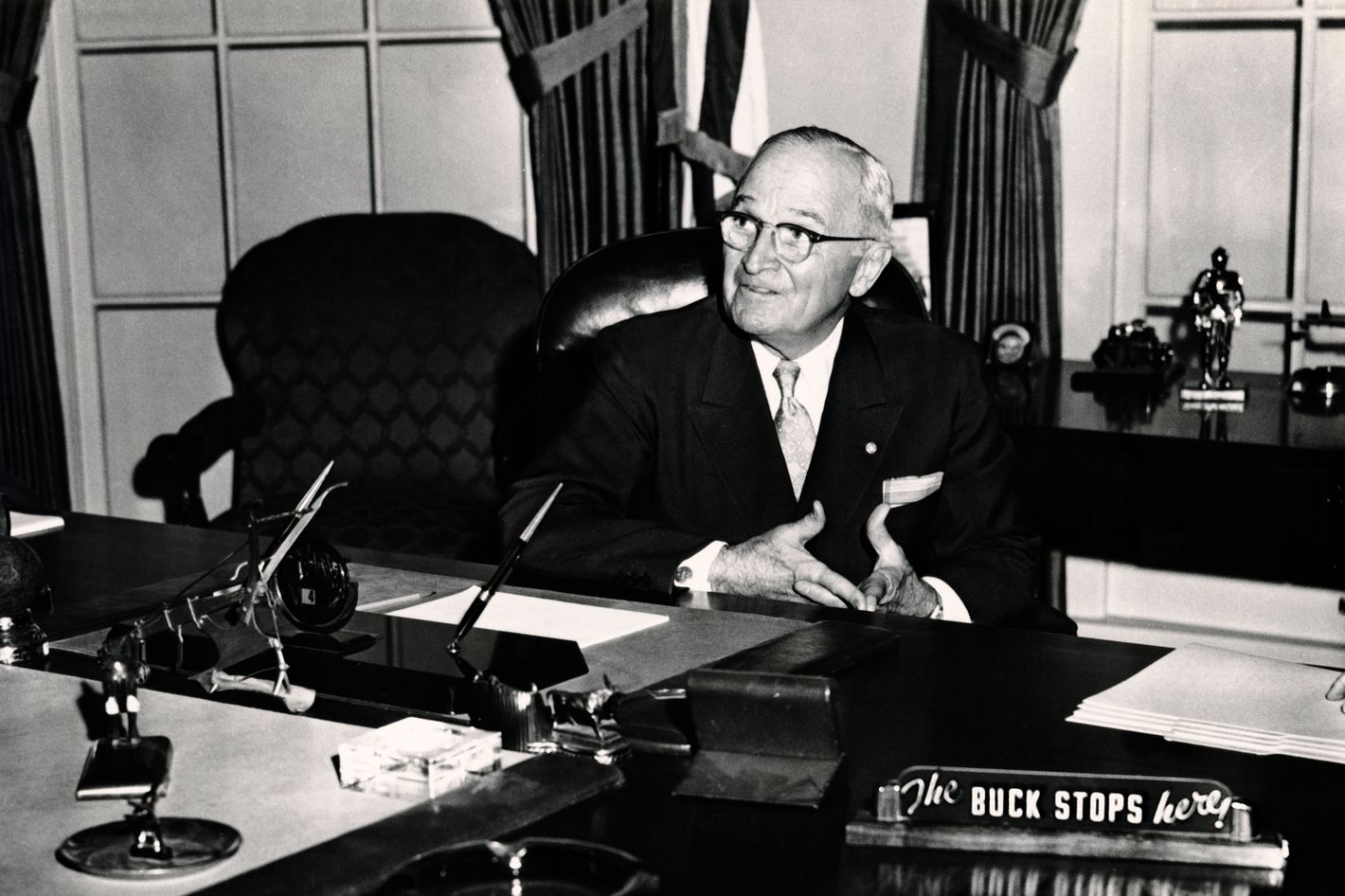
Harry Truman said: The Buck Stops Here
Years ago, our 33rd president had a sign on his desk that read: "The Buck Stops Here!" Even if he was not to blame for a problem, it was his responsibility, as it happened on his watch. Contrast this with our 45th president who takes no responsibility for any of his mistakes. When push came to shove, he was too busy trying to be reelected than to do the job of keeping America safe.
As much as I felt that stopping the flow of people between the United States and China in January was Xenophobic and not called for, I now realize that this measure didn't go far enough to keep America safe from the Coronavirus. For any measure to be effective, we'd have had to quarantine ourselves off from the world, and then do whatever was needed to identify and isolate any carriers of the virus who have already made it to the United States. Unfortunately, our president claims that his January action was appropriate. He will never acknowledge that his half assed actions and cheerleading was not enough.
When the virus started to become an epidemic inside the United States, we were ill prepared. Little did we know that so much of our medical supply chain came from outside the United States - mainly from China. We didn't have enough Personal Protective Equipment (PPE) for the people in our hospitals and nursing homes, much less the people who had to interact with the public on a regular basis. Globalization failed us. In this regard, the rhetoric from our 45th president was correct. But he was a fatally flawed messenger for this message, as most of his branded goods came from the very countries he condemned. Yet, Americans rose to the challenge and started to make many of the goods we needed to help survive the pandemic. Even with this, we needed to import many of the products needed. And our federal government became a hindrance, as it delegated all pandemic related public health responsibilities to the states. It also bid against the states for the very same goods the states needed to help deal with the pandemic. In fact, one state's governor had to arrange for a secret shipment of South Korean goods to American soil, as he rightfully felt that the federal government would illegally confiscate these goods for its own use. Of course, it didn't help that the federal medical reserve was being managed by the president's son in law - someone totally out of his league for the responsibilities thrust upon him.
By the time the economy started shutting down in March, the Northeastern United States was the hardest hit area in North America. The United States, Canada, and Mexico officially shut down their borders to "tourist" traffic, but allowed essential trade and cross-border services to continue. ("Essential Workers" who worked on the other side of the borders were allowed to continue commuting to their jobs. Other people were stopped at the borders.) The New York Tri-State region was "Ground Zero" for the pandemic in North America. From being one of the busiest areas in the world, New York City's streets were empty. One could easily walk across Broadway in the middle of the day without worrying whether any vehicle posed a threat to one's crossing the street. Almost no one was on the road, save for ambulances, fire trucks, and police cars. Almost everything was closed.
Between Mid March and Mid June, the Tri-State region suffered its greatest losses. New York's governor was holding daily press conferences to give current status reports on the number of people suffering from the virus and the number of people who died of the virus. (My father was one of these people.) Nursing homes did not have enough PPE for their staffs. Yet, our president didn't bother invoking the Defense Production Act to make most of the needed goods when we needed them most. Instead, he allowed slaughterhouses to continue with their "Covid-19 unsanitary procedures" (my phrase) in spite of the fact that their workers were getting infected with the coronavirus due to poorly designed work areas. (These work areas are still not redesigned, and the federal government still ignores the health of the low wage workers in these plants.) While people died, our president kept saying that when summer comes, the virus will magically disappear. (Bob Woodward's recent book, Rage, shows that the president knew he was lying when he made statements such as this.) And to be more galling, our president claims that millions of people would have died if he didn't act. Hmmm. Maybe if he had acted more decisively earlier on, we'd have much less than 220,000+ deaths.
Unfortunately, the coronavirus became a political issue, separating political tribes. States where the virus hit hardest tended to vote Democrat, while those where it had yet to hit hard tended to vote Republican. So our president did not feel any need to help his opponents. In fact, he tried to make New York's governor look bad, and Cuomo did not take the bait. Instead, Cuomo deftly managed his relationship with the president, so that the federal government would not interfere with the efforts that states in the Northeast were making to deal with the pandemic. By the time New York (and the rest of the Northeast) got the virus "under control" so that it could relax restrictions on the economy, the virus had started affecting the rest of the United States. Because of this, New York, once the pandemic pariah of states was able to have the last laugh and require people from outside the Northeast to go into quarantine upon entry to the state. Sadly, the use of face masks became a symbol of which political tribe one belonged to, and a symbol of the success or failure of a state's efforts to tame the virus.
From the very beginning, our president dismissed the problems that the virus was causing, and made the reopening of the economy his highest priority. Unfortunately, he didn't understand that he should have been modelling appropriate hygiene by wearing a face mask. So most people from his tribe ignored directives meant to encourage social distancing and the use of face masks, enabling the virus to spread like wildfire outside the Northeast. It didn't help that our president was running for reelection, and held "super spreader" events which made it possible for the virus to infect many more people than had the behaviors in the Northeast had been modelled. To make things worse, governors of many states (mainly in the South and West) ignored the lessons learned in the Northeast, as they wanted to be seen as loyal to the president. Luckily, lessons learned in the Northeast regarding how to treat coronavirus patients helped to keep the death rate lower than it might have been otherwise.
It is now 7 months since the pandemic changed all our lives, and the president has been infected by the coronavirus. He continues to act as if it was a intense case of the flu, and nothing to be worried about. That may be easy for him to say, as he has the best doctors on call and he doesn't have to pay for treatment. But what about the rest of us? How many of us can afford medical treatment (and aftercare) needed to survive the virus? How many of us have doctors with up-to-date coronavirus skills to keep us alive? How many of us will suffer if Obamacare is ruled illegal on a technicality by the Supreme Court? What will replace it? Our president (and his political party) have demonstrated no plan to replace it. They don't care what happens to the public.
As for me, I know how I'm going to vote. And it won't be for people who have mismanaged things from the beginning. Hopefully, you will consider this when casting your vote - your life may depend on your decision....
In order to understand what is going on with this year's election, one has to understand history. In short, one has to understand what led up to the Great Depression, what led up to Iraq War #1, the Bill Clinton presidency, the George Bush (#43) presidency (especially the response to 9/11), and the Obama presidency. In the light of history, everything going on makes sense, and I'm still surprised that only the Libertarians have emerged to be a potential disruptor for this election.
Let's look at the Bush #43 presidency first. He was elected with the mantra of "Compassionate Conservatism" infusing his campaign. One would have expected him to be a president who focused on domestic affairs. He did push a reactionary conservative agenda to appease the hard liners of the GOP base, and did appoint many conservatives to the courts. But 9/11 threw him and the rest of the country for a loop. Politically, he couldn't allow another terrorist attack to occur without an appropriate amount of security theater - so we built up much of our dysfunctional security infrastructure in his reign. But he also had to get us into a never-ending war, where we disrupted the power structure in Iraq, allowing ISIS to form.
Next, we have to look back at the Bill Clinton presidency. Bill was a sex addict (no surprise, FDR and JFK also "suffered" from this affliction). But Bill succeeded beyond anyone's expectations, leaving the US with a treasury that was spending less than it was taking in. Yet, his presidency was marred with scandals (something common in politics), and his wife was tarred with the same brush that tarred him.
Bush had a choice - should he borrow to pay America's bills for a war in Afghanistan, or should he raise taxes to pay for the war? He chose to borrow AND decided to cut taxes - leaving whoever would following him with very tough choices - do we cut the military or social spending budgets, and which line items are sacred? Luckily these tax cuts were temporary, and would expire after he left office. They were designed to make a Democratic president look bad, as no Democrat would touch social spending - so he would have to let the tax cuts expire, allowing the GOP to claim he raised taxes.
The GOP has a mantra of "Less regulation brings on greater prosperity." When the economy collapsed in 2008, a smart GOP candidate would have to ask the question: "What happens if we continue our dysfunctional policies? Could we have another Great Depression?" And I'll bet that John McClain realized this in 2008. Could he tell his party's loyalists that they needed to pump money into the economy AND impose new regulations on the banking sector of the economy? Of course not. So he made a decision that he'll never admit making - to trash his chances of being elected President by nominating Sarah Palin for the office of Vice President. (But he had to play dumb. Any hint that he threw the election would damage his stature in the GOP - and he hasn't admitted that he did this yet, and I doubt he ever will....) John McCain was very aware of what happened to Herbert Hoover. His administration was blamed for the Great Depression, and the Democrats held the office of the President for 20 years under FDR and Truman. I'm pretty sure that McCain figured that the GOP could brush Bush #43 under the rug, and possibly tarnish the Democrat (Obama) so the GOP could win in 2012.
Obama is elected in 2008. We know from recent history that the GOP opposed everything he tried to do to prevent a Great Depression. But both Bush #43's advisors and Obama's advisors were working to script legislation to prevent the worst from happening. And Obama was more successful than expected, in spite of the GOP. He knew not to shred the social safety net while things were getting worse, and then to take away the extra support when things got better. No matter what people did to find scandal in his administration, his was the cleanest we've had in decades.
During Obama's administration, the GOP regained control of congress. And repealing Obamacare became a new mantra. Hillary Clinton takes on the job of Secretary of State, dealing with many of the foreign policy decisions that Obama doesn't have the time to make, being involved in the domestic economy and its problems. But this places her back in the cross hairs of the GOP's attacks on her. If they could have convicted her of anything, they probably would have done so. But the most they could do is to tarnish the reputation of a woman because she was married to a president of the opposition party who was very successful and very flawed.
The GOP congress was ineffectual in delivering on its many problems, and many in the base stopped believing in the lies told by its elite. So, Donald Trump became a great disruptor. Voting for Trump was a vote against the GOP elite. Sadly, Trump is a person who leaves anyone and anything he touches poorer for knowing him. But one would have to know his history to think he's anything other than a successful entrepreneur.
At the same time, the Democratic elite was also shown to be worthless, leaving fertile ground for Bernie Sanders' candidacy. If it weren't for Bernie NOT realizing how powerful his message and candidacy would become, and how the Democratic party's elite structured things for Hillary to win, he might have just pulled up the upset of the century.
Now we have Hillary Clinton and Donald Trump as our presumptive nominees. They have the lowest approval ratings in decades. And the Libertarian, Gary Johnson is polling in the double digit range. Will he be able to keep polling this high and get into the debates? I'm not sure, but he is another disruptor. If Johnson were to win any electoral votes, and if neither Trump or Clinton win a majority of electoral votes, the presidential election could go to the House of Representatives. Would the majority GOP states vote for Trump, or would they do something embarrassing like voting for Clinton? I suspect that neither candidate would be acceptable, and this would leave the Libertarian (who is, I believe, a former GOP governor) as the only palatable choice.
Could this scenario happen? It's highly unlikely, but we've seen the strangest things happen this year, and I'm not ruling out even stranger things from happening.....
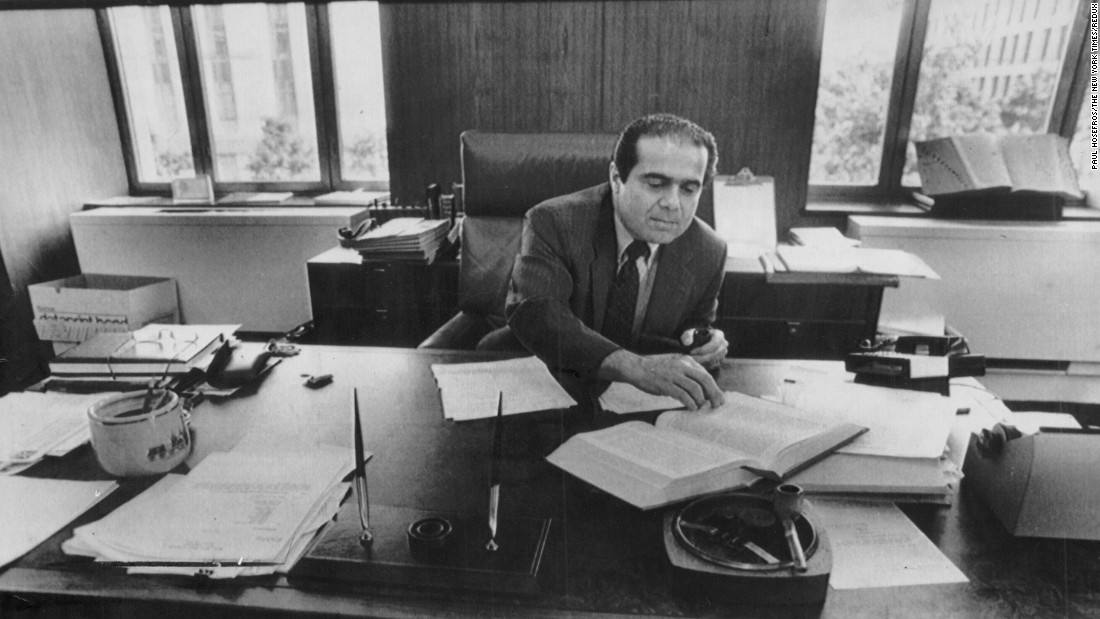
In fairness, I did not want to malign this man (whose opinions I usually disagreed with), but to note his importance to America. Yet, I had to choose a picture whose tone best fit what people thought of the man - for better and worse. So I chose a monochrome image of Scalia, as he tended to see things in Black or White, and not with the conflicting nuances that many people live with.
- - - - - -
This justice was a devout Catholic, a person who took 6 day creation as real (from what I've heard - which may or may not be entirely accurate). His life and his court decisions were influenced by his lack of doubt about anything. And this is where I fault the late justice.
One of the things I learned in Grad School was the idea of "Transformative Learning". This process involved a person doubting one of his/her core beliefs, and developing a completely different world view after examining the facts and testing his/her beliefs. From what I can tell, Scalia never had a transformative learning experience, as none of the reports I've recently read note that he had doubts about his beliefs.
Please note that I am not out to trash this man or his legacy. I have much to criticize about his believe in "Originalism" - it lends itself to the same intellectual stagnation found in many ultra-orthodox followers of religious faiths. They tend to argue over minor points, but never question whether the big answers provided to them are really indicative of a true right or wrong. Dogma is more important than what any law is supposed to provide for a society - a way to determine what is the right or wrong thing to do for the average person who has no time to learn all the details....
Why is this important?
As much as I dislike what Scalia stood for, I have to grant him credit for being consistent in the application of his core beliefs. But I fear having another person without doubt in any position of power. I'd have wanted for Truman to question whether dropping the A-Bomb on Hiroshima was the right thing to do, and then justify it to himself by the number of lives s shortened war would have saved. Can we afford to have another dogmatic person on the Supreme Court? I doubt it.
At the time I write this entry, the president hasn't nominated a successor to Scalia, nor has the Senate indicated any willingness to hold a vote on any nominated candidate. The GOP has signaled a desire to roll the dice and wait until the next president is in charge, where there will be a 50-50 possibility of the GOP putting in a radical judge. However, Obama could make a recess appointment (which I find doubtful for the time remaining in the week of 2/15-2/21) of an extreme liberal - who would be on the court until the end of the term, and be a deciding vote in the more divisive of potential decisions. Or, he could nominate a moderate, and let the GOP take the heat for not giving the person a quick vote. Either way, the public is now aware of how important the Supreme Court is to America.
Would we be better had Scalia lived?
The answer to this question depends on which political party you belong to, and what your core values are. I want the court stacked with social moderates - people beholding to neither political party, and who will check and balance the extremes of our elected leadership. Do I think this will happen? Maybe - if we're lucky....
From what I understand, our forefathers thought that the Speaker of the House of Representatives would be America's most important political position, and not the office of the President. However, it is the presidency which has become the most important office - and for good reason. As Harry Truman said: "The Buck Stops Here!"
Lately, no sane man would consider the position of Speaker of the House. Rep. Boehner resigned, as he felt that he couldn't control the extremists in his party and get them to vote on "must pass" bills needed to keep the government running. He was tired of the responsibilities of the office, and decided to retire instead of destroying himself by staying in the battle. But this left Rep. McCarthy next in line for the office.
There are many reasons why McCarthy should not be Speaker of the House. But I won't go into the ones that many Democrats might bring up. Instead, I'll trust his judgement that he is not the right man for the job, and speculate that he did not want to take the blame for a likely government shutdown (which would likely happen by the time this entry is made public). He's smart enough to know that the same angry people who are propelling Trump's candidacy are also the same people who no longer trust political insiders to do anything to address their concerns. They feel they have nothing to gain by keeping the present elite in charge, so they are willing to collapse the system to make their voices heard.
But what does this mean for our "democracy"?
If the House was designed as a place where the people could vent their feelings, and the Senate was a place to prevent short term feelings from mucking up the system, then what happens when the legislative branch is dominated by a party which is unable to govern? To me, this forces a president (most likely from the opposing party) to govern by edict and by novel interpretations of existing law. This is very dangerous, as power keeps shifting from the legislative branch to the executive branch - and this power is subject to fewer checks and balances as time goes on.
Eventually, one party will control the two elected branches of government. And if the party is as dysfunctional as today's GOP, then I have serious concerns. The angry mob that is disrupting the functions of the House could gain control of the executive branch - and that could be the end of the republic.
Why such a concern?
Let's take an inflammatory issue such as abortion. Many scholars thought that Roe vs. Wade was a horrible decision - not because of which side won, but because it forced society to adapt too quickly to change. Later rulings have softened the blow, and have rolled things back a bit. But they (SCOTUS) have always relied on judicial precedent to guide them in new rulings. What would happen if a new, replacement elite were to ignore precedents? The loss of abortion rights in themselves might not be that onerous. But could you imagine possible government intrusion in a woman's reproduction to make sure that all fetuses are tracked and accounted for?
Long term government policies that cross administrations could also be overturned at a whim. Could you imagine the lunacy of a rapid rapprochement with North Korea? Heck, Cuba and Iran have never been as much trouble to the US as the DPRK has been, and yet they get all the press these days because of a slow and careful movement towards normalization with these countries. Would we kill NAFTA without serious thought? Possibly. But this is why our government was designed to implement change slowly - so that we don't make the mistakes often made when the voice of the mob drowns out the voice of reason.
But what role should an elite play?
This question has been central to American polity since the days of Jefferson and Hamilton. As for me, like Hamilton, I believe that there is a natural elite that tends to form in any society. But like Jefferson, I also believe that to be free, "the tree of liberty must occasionally be watered with the blood of tyrants." America has been a stable republic because its design provides for a greater tolerance of instability in the system. I only hope that the design keeps working - and I'm not too sure of this any longer....