Showing posts with label United States. Show all posts

Thursday, March 14, 2019

Some impromptu thoughts on healthcare and the United States


I started writing this entry because of a post I read about Canadian health care....

- - - - - -

Let's strip away all the political rhetoric and look at the facts. For goods and services whose demand can be affected by external factors such as cost (i.e. elastic demand), markets are the best way to allocate resources. Health care (a product with inelastic demands) does not behave this way, as no one bleeding to death will ask how much does it cost for a doctor to fix me? For goods and services like health care, other, more efficient methods have to be devised to best allocate resources.

Let's take away from our argument the idea of charity hospitals and doctors practicing without regard to money. The number of these people and organizations is shrinking, as states have allowed medical organizations to be profit making organizations. This has led to markets being used to allocate resources where markets are not the best way to allocate resources.

In a society that values human life more than ours, people's lives are maintained without regard to market forces. The individual receiving health care is not part of the market. So, how is care allocated? In the US, we used to have organizations called HMO's. But even they were affected by markets, and limited care when care was needed.

Many developed nations, such as Canada provide health care services with a fixed amount of money allocated for care in each province's budget. People get to see their doctors by appointment (usually more often than in America). Care provided has been vetted against "best practices" and drugs/procedures which provide the most bang per buck are usually chosen to reduce costs. In areas where there might be inflexible demands, such as needing heart transplants, they prioritize recipients of care to those who would get the greatest statistical benefit from that care. This means that a 40 y/o man might be selected for a transplant over a 90 y/o man. This takes market forces out of the decision, and allows care to be provided without regard to a person's wealth or lack of it.

America has distorted the use of markets so much, that many of us fear what might happen if we move some goods and services out of market place allocation of these goods and services. The experiences we've seen in foreign lands shows us that costs can be reduced by taking things out of markets. In fact, we're now seeing medical "tourism" where many Americans are flying to Europe and Asia for non-emergency procedures. There are many procedures that cost half as much when done in Europe than when done in the States. In Asia, the costs are even lower. And, quality is similar (or better) than what one finds in the States.

The drawback - no one likes being a gate keeper. No one likes having gate keepers. And non-market systems require gate keepers. Who wants to hear that a $500,000 procedure won't be performed that could add another year to your 90 year old grandma's life, because society has chosen to fund a rural clinic that provides 10,000 people with essential health care?

Being a decent human being means making choices. Canada and most of the developed world have made good choices. America  doesn't yet make that many good ones....

Wednesday, February 8, 2017

A modest border proposal


Like our president, I want to build a wall along the border with Mexico. But I don't want to build a wall that separates our peoples, but builds links of friendship across the border. 


- - - - - -


There is a famous play about two men who build a fence between their properties.  They both wanted their children to want to get to know each other, and they figured that the fence would get their kids interested in knowing each other.  It's a famous musical, and one well worth seeing if you get the chance. But I'll be darned if I can remember the name of that play now.

Since this wall is to be built for purposes of friendship, I propose using both Mexican and American children (of various ages, all under adult supervision) to build this wall as play, using Legos as their prime building material.  The wall would be 50 Meters long, by 1.5 Meters high, and 20 Centimeters thick. At the center would be an American hand shaking a Mexican hand in friendship. This wall would be the first wall built to bring people together, and not keep them apart from each other.

- - - - - -

Our current president wants to force Mexico to pay for a wall that its people do not want. He has just suggested that he is thinking of sending our troops South of the border to deal with "Bad Hombres" in Mexico. Is this the way to make friends?  I doubt it. Our Southwest was settled by people of both Anglo and Mexican heritage. And it's about time we stopped being the bully, and treated our next door neighbor with respect.

Something that most people don't realize is that there is already a wall along parts of the USA/Mexico border. It hasn't solved out problems with Mexico, it has only made them worse.  If we were to build Trump's wall along the border, we'd spend at least $25 billion for materials alone - and that doesn't account for the cost of labor.  Is it worth the price?

One might say, what about all those people crossing the border?  We have a right to keep them out. And this is a valid point. But many Mexican illegal aliens are moving back to Mexico for reasons of opportunity. NAFTA has helped Mexico develop, and we no longer have as big a problem with illegal immigrants crossing that border as we once did.  Instead, we're being infiltrated by illegals flying in from overseas, then overstaying their visits. And our President's proposed wall does absolutely nothing to stop them.  Instead, he's making a symbolic gesture which will accomplish little in the long run.


- - - - - -


Another person might focus on drug smuggling and other crimes which involve border crossing.  And to them I say that we should rationalize our laws. Making recreational drugs illegal has only served to act as a price support.  Berkeley Breathed (of "Bloom County" fame) made a point of this when a "hair growth tonic" was made illegal, and h ad Opus say "thanks for the price support". He then made jokes about all the ways drugs could be smuggled in, and showed how stupid many of these laws are.  To me, the only way to beat a narco mafia is to legalize and regulate such substances, killing off the profit margins.

How many people know that the laws against Marijuana were written to deny Mexican Americans their presumed drug of choice?  In the early days of the 20th century, Opiates were banned to deny Asians a recreational drug. And in the 1930's, Marijuana was banned to deny Blacks and Mexicans their fun.  Booze was made the only recreational drug available to the masses after prohibition ended - and we suffer from that decision today.

The Narco Mafia understands that drug bans only serve to increase their profit margins. But they have had a perverse side benefit.  They now take people from South of Mexico, move them through Mexico, and use these people to deliver their drugs into the USA.  They have taken over the "Coyote" trade, and have little interest in delivering people safely across the border to their final destinations. They have found another business where government provides them with price supports.


- - - - - -


If the problem is with the illegal alien, then we must do two things.  First, we must deal with the 12 million illegals already here. And for them, I want one last amnesty using the model established under Reagan's presidency.  But I do not want these people to ever become American citizens. Instead, I want them to be "green card" holders, so that they do not disrupt American politics in my lifetime.  Second, we must prevent new illegals from finding work, making it a criminal offense to hire (or otherwise employ) people who are not citizens or green card holders. And we must mandate the use of technology that would allow an employer to verify that a person has the legal right to work here. (We could also offer a bounty for those who lead the government to a successful prosecution of employers who violate this law.)

Americans need to feel secure.  And Trump's wall only provides an illusion of security. However, true friendship can provide the security we need, as friends can and will look out for each other....

Thursday, January 1, 2015

Another year over, and a new one just begun.


As usual, no one knows what will happen at the beginning of the New Year. But we do know that the old year brought a lot of change. And this year was no different. There were many changes, and yet, the world remained much the same as it has always been - an orb where over 7 billion people repeatedly fight to make it through another day of life.

The New York Times Sunday Magazine has put out its usual memorial issue, where they commemorate the lives of those who have passed. And we are reminded of what we have lost, not knowing what we will gain in the years to come. There are many great people we have lost, some famous, and some who are not. But all have a commonality to them - they have made an impact on our lives.

We have seen the development of new enemies, as well as the neutralization of old ones. Who'd have thought that ISIS would be a major concern a couple of years ago? Who'd have thought that North Korea would attempt to threaten Americans if they watched a mediocre film that cast their leader as the focal point of bad humor? Who'd have thought that the USA would be working with Iran, and deescalating years of tension between the countries? And who'd have thought that the United States and Cuba would be normalizing political relations with each other?

Much of the news was controversial - not only because of its content, but for what it meant about the people being reported on. In the case of the Senate Report on Torture, we found that the CIA made a cascading series of moral mistakes after being charged with gaining information from GITMO prisoners, and then did whatever was in their political power to cover up their actions. Yes, the report was going to be political in nature - could anything coming out of Washington, DC not be political?  What saddens me most is that many Americans are so happy to use torture as a tool, forgetting that even our captives deserve to be treated as humans. in accordance with treaties signed by the United States.

But who could have foreseen the Pope chastising the Roman Curia? Of all 2014's events, this one seems the most amazing, as religious leaders have not sparked as much change as this Pope seems to have done. Without changing a letter of dogma, he has changed the focus of the message. Instead of rigid obedience and conformity, it is now one of forgiveness, tolerance and hope.

As they say, "the more things change, the more they stay the same." And this has been true about 2014. Hopefully, we'll see 2015 show more of the good side of humanity than 2014 did....


Saturday, December 20, 2014

Even Eric Cartman couldn't cause this much trouble


I'm disgusted!  An all but acknowledgement of state sponsored terrorism, and no way to deal with the criminals behind it. (And if there is a plan, our government is not talking about it.)

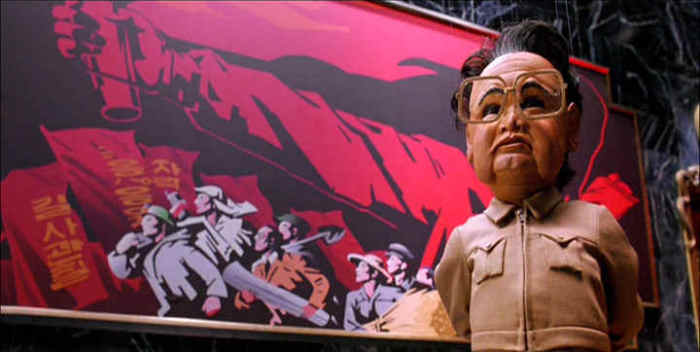
We have just seen our 1st amendment trumped by a terrorist threat to bomb movie theaters that show "The Interview" - a film about two people being recruited to assassinate the leader of North Korea. Sony's computers have been hacked, theater chains refuse to show the picture, and the public denied the right to see a movie previously scheduled to open on Christmas day. Even worse, when theaters decided to show "Team America, World Police" instead, Sony shot down their chances of showing this film as well.

I never thought we'd see our freedoms at risk this way - Americans are running scared because of a threat from some unnamed hackers. North Korea is a basket case of a country, and one that will eventually collapse if both China and the West stop bailing it out. Sadly, there are problems with this. The South Koreans can't afford to rescue the North, the Chinese don't want a reunification that puts a strong American ally on its borders, Russia has a veto in every possible situation, and the Americans have every reason to wait things out. So North Korea continues to exist, blackmailing the major players in the region for what the dictatorship needs to survive.

But what would happen if we looked at this situation as an opportunity?

There is an old saying: "They shoot horses, don't they?" And maybe this is how the Americans, Chinese and Russians should think about North Korea.  What would happen if all possible opposition were neutralized in the North, and the three major powers were to create a consortium for the extraction of rare earth minerals - raping the land (something already being done) for their profit, instead of that of the Kim regime?

Yes, I am talking about the destruction of a nation for profit. But I doubt that anything could save the North Korean people - at least not at the prices that any of the stake holders are willing to pay. But please remember that I pose this "modest proposal" only as a thought experiment, and one meant to change how people are thinking of the problem posed by North Korea.  There are millions of lives at stake. And eventually, someone will have to address their needs when North Korea self destructs....


Thursday, December 18, 2014

A long needed thaw - something I never thought I'd see....


This is what most Caribbean nations dependent on tourism feared - the United States and Cuba gradually warming up to each other. There are so many things which should be binding the two nations together, but for bad politics (on both sides) and an assassinated American President that got in the way of common sense.

One person told me that addiction is similar to having to choose between opening two doors. The first door will allow you to exit the room. The second door will have you beaten up by a gorilla. The addicted person keeps repeatedly choosing the second door, while the non-addict will quickly choose the first door and leave the room. When the addict is asked why he keeps choosing the same door, the addict will respond with something to the effect - well, it can eventually change, can't it?

Our policy towards Cuba has been very much like that of the person who keeps opening up the wrong door - the Castro regime has not been ousted, and it has become even more entrenched over the years. Many people want to punish Cuba for its actions of 53 years ago, but most people alive today weren't alive when the embargo was put in place. What good does punishing a country do when the people being punished are not responsible for the problem. This punishment seems to be a misguided approach to keeping the first generation of Cuban exiles happy and voting according to their current patterns.

Most people don't know that it is perfectly legal for Americans to visit North Korea, a country more troublesome to American interests, and spend money there. Yet, in a country that has not been shown to sponsor terrorism (save, in the figments of collective Washington, DC political imagination), it is effectively illegal for Americans to be there. Something is very wrong - and it likely has to do with American political paralysis.

There are issues that will need to be negotiated before a full thaw has occurred. And they have nothing to do with promoting democracy in Cuba. Instead, they will have to do with trademarks and the exports of certain goods. For example, Bacardi Rum got its start in Cuba. The family took the brand along with them when they left Cuba, and established it in Puerto Rico. Do you think they can afford to have the Cubans sell rum under the Bacardi name after the embargo is lifted? Another example is Cohiba cigars. The brand available in the USA is made in the Dominican Republic, while the brand available in most of the world is made in Cuba. How will this get resolved?

If anyone brings up the idea that Cuba stole property from its rightful owners, it should be noted that Russia and China have done the same thing, and that the United States has relationships with these countries. In fact, one might find the history of Smirnoff Vodka interesting, as the trademark left Russia - and when Russians resurrected it in their own right, a "peaceful" settlement was reached. This makes me comfortable with the idea that both the United States and Cuba will resolve issues like this to their mutual satisfaction.

Obama, like him or hate him, is a person who plays the long game. The game with Cuba will play out long after Obama is out of the game. It will take time to negotiate and resolve the issues that have arisen over the 53+ years that we have had an embargo. And the negotiations have only just begun....