OK - I'm not too original today.... But the recent sale of AOL to Verizon made me think of Wall Street, and how it has a nasty habit of creating deals that squander more wealth than those deals create.
- - - - - -
Let's look at the case of AOL. Years ago, it dominated the dial-up internet market. I'm pretty sure most of my readers remember how ubiquitous AOL software CDs were in the 1990's and early 2000's. One couldn't help but get several of these disks every week - and AOL made a lot of money way back when.
At the peak of the market, AOL bought Time Warner. For AOL stockholders, this was a great deal - it gave them real long term value for the stocks they held. However, for Time Warner stockholders, one has to ask - what were these idiots thinking? Yet, no one blamed the advisors at the investment banks (organizations such as Merrill Lynch, Morgan Stanley, et.al.) for selling a questionable bill of goods to Time Warner stockholders - many of whom saw the value of their assets plummet. However, the investment bankers made out like the bandits they were. Eventually, the combined AOL Time Warner got smart - and unloaded AOL. Of course, these same investment bankers made even more money for handling the transaction. Was there any real value generated in either of these two transactions? No. But the investment bankers extracted their share of wealth - and passed it along to their upper managers.
Today, as I started writing this entry, Verizon has just announced that it was buying AOL - in part because of its mobile content. It seems like the same story, but different characters. In this case, AOL brings to the table some technology and some media that Verizon claims to need for its efforts to get people consuming media via cell phones. Does anyone really believe that AOL, with its history, has much to contribute to Verizon?
- - - - - -
Over the years, we've seen many deals orchestrated by Wall Street that made no sense other than to line its coffers. The deals get made, and then a decade or so later, they get unmade. The only deals that ever make sense are those that allow for consolidation in shrinking markets, or for those which allow for expansion in growing markets. Yet, the vast majority of deals do not meet either of these two conditions.
A few years ago, a major Wall Street financial services firm (with a bank charter) ended up merging with one of its major competitors. Upper management claimed that value would be added by "synergy savings". (Read: Layoffs). The two firms merged just before the 2008 financial panic, and made sure that its layoffs were made on time, so that the firm could meet its financial numbers. However, a goodly number of the tasks required to integrate the two firms were left undone - and this created an unwieldy infrastructure which cost the firm more money than if they had missed their numbers for a quarter. (In 2008-2009, no one was hitting their financial targets.) Several years later, the same firm had expenses 120% of that of its peer group - and the only option it had left to make its numbers was layoffs.
Would this organization have been better off had it not merged two competitors? I don't know. But neither organization would have been wasting time trying to integrate two very different firms, and neither organization would have been number one in its market - leaving room for either of them to steal each other's market share, instead of having to perform the harder task of protecting a number one market share. In short, being at the top of the heap limits the organization's room to grow, while being number two, three, or four allows for greater competition, greater innovation, and greater returns to stockholders.
- - - - - -
I'm not saying that all deals are bad. Some deals can be quite good, if performed with the right partner. For example, it was a big mistake for Daimler-Benz to purchase Chrysler. They had no way to integrate corporate cultures, and there was no "synergy" (I hate that word), as Chrysler had nothing to offer Daimler-Benz. Eventually, Chrysler ended up in the hands of Fiat.
Now, Fiat had an interesting history of its own. GM had the option to purchase Fiat, and bailed out - costing the firm a lot of money. Fiat found a way to become financially strong, and saw an opportunity in buying Chrysler that Daimler-Benz didn't have. For Fiat, Chrysler became a springboard into the United States that Daimler-Benz didn't need. Some of Fiat's technology made it into Chrysler cars (e.g. the current Dodge Dart), and some of Chrysler's product line became available to Fiat (e.g. the Jeep). Here was a merger that could work over time.
- - - - - -
Why is this important?
Wall Street will be playing a major role in next year's presidential elections, as it will be throwing money at all the major candidates and expecting a return on its investments. The investment banks will want to keep making value consuming deals, and expect the taxpayers to subsidize their losses.
Can we afford to allow them to get away with it anymore? I doubt it.....
It never fails to surprise me about how little people retain from each day's news cycle. A few weeks ago, Obama's warming up towards Cuba was big news - and the "conservatives" were all chastising him for abandoning tactics which have been proven not to work. The same thing was done with Iran - and again, it was big news for a few days, and almost forgotten. We're seeing public opinion swayed by talking heads, in ways that George Orwell could only dream of....
Orwell, in "1984", presented a public speech where someone was ranting about one enemy, and in the middle of the speech the enemy changed. The former enemy was now a friend, and the former friend was now an enemy. Although this type of change isn't happening as fast as in Orwell's novel, we're already seeing this in our media. How many of us remember when our enemy was "godless" communism? And now our biggest trading partner is the People's Republic of China - governed by the Communist Party.
Although George Washington warned us against having any permanent entanglements, I don't think that he would believe how quickly the world changes in our lifetime. My father has seen Germany and Japan go from being friendly countries, to enemies, and back to being friends. And in my lifetime, I've seen the same happen with Vietnam, and am seeing it happen with Iran and Cuba.
- - - - - -
About 50 years ago, the city of Baltimore had its riots. And now, it had another round of riots. The problems are the same as they were 50 years ago - a general lack of economic opportunity. Americans will forget about this round of riots, as they have other important things in the news. But will we learn from them?
This time, we're seeing people around the world "armed" with cell phones (most of which contain the latest software) and active internet connections. Even in Iran's riots of a couple of years ago, the central government was unable to suppress all the news from getting out of the country. It couldn't suppress the news being passed along by its citizens. And the same thing happened here - the Baltimore Police could no longer cover up what triggered the riots - a "thug" whose rights were ignored by the police, and a death that couldn't be ignored.
Now, I've just used the word "thug" to describe this person. But is he as bad as the label I've attached to him? In an area as economically depressed as his section of Baltimore, over 56% of the adult male population is unemployed. Dr. Phil noted in an interview on Fox News that the people living in these poor sections of cities may have the same potential, but not the same opportunities, education, or inter-generational social pass-throughs. Was this person's rap sheet caused by a defect in this person's character, or was it caused by the environment he lived in?
- - - - - -
Two generations ago, we didn't need to worry about the problems of structural unemployment. Today, both people in the inner city and the suburbs are affected by these problems. The low end jobs which were stepping stones to greater opportunities no longer exist. Low value/High Labor cost manufacturing left the United States years ago. Computers have replaced humans in many tasks which would have provided work - the computer managed "help lines" we call are perfect examples of this. It is cheaper to have a human interface with a series of telephone menus than to reach a real, live, flesh and blood human. And society no longer provides the full and free education needed to fill the jobs of tomorrow.
Our college education system has been corrupted by government funding - instead of having our government expand access to college by building more colleges, we've seen our government increase the monies available to students in student loans. Simply adding more money to buy more education doesn't do much good - it only raised the nominal price of an education, making it much harder for both the poor and the middle class to afford college. And for those that got the student loans, they often now have onerous debt to repay, and are deferring having children. (I'm not even talking about those who took out predatory student loans issued by for-profit colleges that provided sub-standard educations - these students were screwed the day they entered school, and no one wants to fix this problem because the affected students come from the lower castes....) Since student debt can't be erased in bankruptcy, we now have a generation of Americans who will not be able to afford what will be needed from them in the future.
- - - - - -
It is very interesting is that the problems that once only afflicted the lower class are now affecting the middle class. Poverty used to be clustered in the inner city and in remote rural areas. Now, we're seeing newly poor people scattered through middle class neighborhoods. Houses are becoming derelict because of predatory lending combined with "Zombie Titles" that insulate banks from maintaining foreclosed properties - Banks are no longer foreclosing on many properties, making it impossible for borrowers to walk away from debt that they can no longer afford. Sadly, this may only be the tip of the iceberg when it comes to what the banks will be doing next to preserve their power in society....
- - - - - -
Where will we end up? I don't know. I'm afraid for our future, as we're seeing the signs of America's upcoming collapse - and we, as a whole, have a lot of questions about our society's future that need to be asked and need to be answered. So far, all our leaders are doing is pandering to us and our fears - they do nothing to deal with the real problems. And this is a great danger that we all should fear....
The above is a collective image of the 6 Baltimore police officers who have been indicted for the homicide of Freddie Gray. Although they deserve a fair trial by an unbiased jury, it was interesting to see how political pressure can be used to redress some of the issues raised by some of the disenfranchised in society.
In the followup to the riots, we saw the Baltimore D.A. take an honest look at the evidence and had no choice but to call for an indictment. Gray was not belted into his seat for his own protection. The police van made 4 stops, not 1 before reaching its final destination. And, the knife once labeled as a switchblade was perfectly legal for Gray to possess. There was enough of a stench coming from the police involved, that even the D.A. couldn't avoid seeing an apparent abuse of police power.
Recently, Dr. Phil was on Fox News, and he slipped through a comment that the talking heads didn't notice. Although the kids in the poor neighborhoods may have the same potential as those in the better neighborhoods, environmental factors may be making it impossible for them to achieve this potential. Around 4:20 (or so) in the linked video, he noted that there are fewer opportunities available for these kids, that the school systems are very different for these kids than those in the affluent suburbs, that fewer resources are available for these kids, and that their parents do not have the "societal" skills to pass on to the next generation (as Dr. Phil puts it - "generational pass throughs").
- - - - - -
I have commented before about the warehousing of excess population in our nation's prisons. I have commented before on the economy of the drug trade, and how it is one of the last "industries" available to poor people with criminal records. I have commented about how people have been turned into 3rd class citizens, and denied the right to vote after serving time in prison. And I have commented before on unequal education in our country. But what happens when these factors are not properly addressed by society - Riots.
Why does this concern me? I don't live in the inner city; I live in the suburbs. The answer is simple. We are seeing the gradual breakdown of society from the bottom up. As the segment of society for whom enough opportunity does not exist grows, the more unrest there will be. When this segment swallows up much of what was once the middle class, I am not sure of how long our democratic republic will survive. I am very afraid of an authoritarian government taking the place of the flawed system we now have.
- - - - - -
When the above 6 police officers were indicted, I found it interesting that the people in the inner city were celebrating. Only time will tell if these officers are convicted. But is this a bone being thrown to the masses to keep them quiet? I am not sure. Years ago, we saw the O.J. Simpson trial on TV. It was captivating, if only because a black defendant had enough money and resources to put up a strong defense and win against a prosecution who had virtually unlimited resources. (It helped that there was a mixed race jury hearing the case, unlike the civil trial held in the L.A. Suburbs.) And at that time, one heard the same cheering among the Black segment of America's population as if "one of ours finally won!"
Law enforcement and criminal defense are two things that differ between the better off and the worse off in our society. In the more affluent communities, police treat residents (for the most part) with respect. If someone has to go to trial, that person generally can muster up enough resources to put up an adequate defense. This is not the case in poor communities, where the police are being used to control a disenfranchised population, by arbitrarily enforcing laws. Because the poor do not have adequate resources to defend themselves in court, there is extreme pressure to plead guilty for lesser prison time. And once out of prison, many poor people are now unemployable in the traditional economy. The drug trade becomes the only business open to these people, creating a vicious cycle of crime, poverty, and hopelessness.
- - - - - -
If one doesn't believe that there isn't an arbitrary standard of justice in this country, look at the latest video by Willie Nelson and Merle Haggard. In it, you'll see an action for which white people are rarely prosecuted, but for which black people are often prosecuted. Depending on the state this video was shot, the action would be legal, be a misdemeanor, or even be a felony.
As much as I love Willie Nelson's music, his use of cannabis illustrates the double standard of justice we have for black and white people in this country. The police have caught him and his entourage with cannabis - and he has never (from what I can tell) spent a day in jail. Can you say this about black people who have been arrested for possession/sale of the same substance?
To me, it's about time that we end the so-called "War on Drugs" and begin reinvesting in the inner city (and its residents). If we don't, are we willing to risk losing the freedoms we have left to a future authoritarian government, just to keep the disenfranchised under control?
Tonight, David Letterman retired. After over 3 decades in TV, the man followed in the footsteps of his mentor, Johnny Carson, and retired while he was on top of his game. I guess his heart no longer said "Buttafuco". (That was the reason Letterman gave for signing up with CBS.)
- - - - - -
Like Carson before him, Letterman was a master of his craft. However, also like Carson, he defined the type of show that worked best in a time slot. Carson took the tonight show, and created an impossible mix - a show that kept you entertained, but if you fell asleep watching it, you'd feel as if you missed nothing while asleep. Letterman did something similar for the 12:30 am to 1:30 am slot - taking a mix of edgier comedy,"dumb" comedy, up and coming celebrity interviews, and targeting a younger generation than Carson aimed for. And, like Carson, he aged with his audience.
If you have been in the public spotlight for 33+ years, there will be a lot of people poking fun at you - as they have with Letterman. In his case, the "Krusty the Clown" character from "The Simpsons" was modeled on his curmudgeonly character traits.
And the creators of the Simpsons helped out with an animated bit on Letterman's final show as a way of paying tribute to the man. But the best tribute may have come from the man hosting the show immediately following Letterman - who did a "Top 10" list during the show, and then at the show's end, rolled watermelons off the roof onto the parking lot below.
- - - - - -
Letterman was not known for political humor, but he didn't avoid a good political joke it it came to him. One of my favorites was:
"Bush presidencies are like Godfather movies - it is best to stop at 2."
If I wanted to, I could find a lot of jokes he may have done about politicians of both parties. But I'm not interested in recycling old humor. Instead, I'm more interested in the fact that the real life Krusty did let his feelings show in public. And it is fitting, that when he exited the building, that he did not go through the the theater's front or side doors. Instead, he made an unceremonious exit through the delicatessen that shared the building, and walked away into retirement.
Dave - you will be missed!!!!!
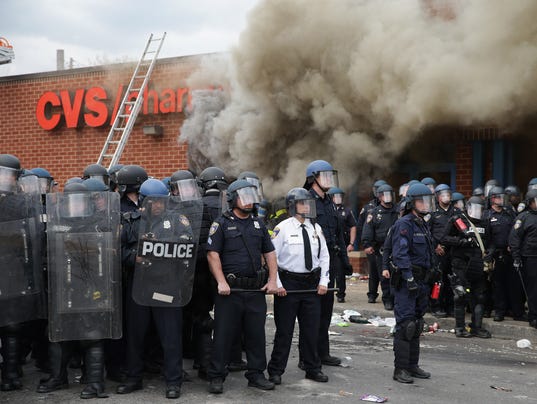
This image makes it seem like the Baltimore police had the situation under control. However, given 4/27's news reporting on both Fox and MSNBC, this would be the furthest thing from the truth.
Normally, I lean left of center (based on today's politics) when interpreting affairs of the day.When it comes to riots, I have no problems with police being able to "shoot to kill". "Why?" you may ask... To me, the answer is simple - a riot is like a quick moving cancer. If it is not put down quickly, a community gets labeled as a bad place to make an investment. And, as a result, there is a loss of jobs which can force the community into an economic death.
Sadly, the fact that riots are taking place are indicative of a bigger social problem. We have an excess supply of people who are willing to work, but can not find gainful work. We have draconian laws (especially in regard to recreational substances) whose net effect is to disenfranchise large segments of the population, to warehouse them where they can't compete for jobs against a blissfully unaware but shrinking middle class, and to function as a tool to keep the lower economic classes in check.
If we look at the people in places like inner-city Baltimore, we see poor people who have poor educations, who will not be able to qualify for the jobs of tomorrow. They are frustrated, and do not have the ability to articulate their complaints against the larger society. Strangely enough, Fox had a reporter on the ground, interviewing one of the locals in front of the police, while MSNBC only had talking heads in the studio. But the message was clear, no matter which side of the political aisle you were on - the people in inner-city Baltimore are tired of living in conditions of little hope.
Watching the Fox interview of the unnamed Baltimore local, I noticed that the local mentioned that he just got out of prison on a trumped up drug charge, where the policeman planted the evidence that was used to convict him. In the past, I'd be inclined to think that this would be someone lying to save face. However, with these incidents (and others) on file, I'm not so certain we can put the word of the police above the average citizen any more:
Can we assume that the police are telling the truth? Not anymore. Yet, I believe that most of the police are getting a bad reputation from these "bad eggs", and from policies meant to detect crimes, even when no crimes have been committed.
Let's assume that this unnamed Baltimore local's statement is true. Then this is the tip of a very nasty iceberg. The people we've entrusted the duty to protect us have become part of the problem. In an article on where Baltimore's police went wrong, the author notes that dealing drugs is the only "industry" left in the inner city - and that our current drug laws are creating a police force that no longer polices neighborhoods to keep them safe, but instead, becomes a tool used to keep the poor and disenfranchised in line, and afraid to challenge the corrupt status quo.
Most policemen starting out are good people who are put under a lot of stress every day. However, our elected leaders set policies that often demand that the police meet quotas to show that crime is being reduced - and our police oblige them, out of fear that they will become victims of politics. Instead of being the trusted members of the community that one could count on to find out who is committing crimes, they become the distrusted outsiders responsible for keeping a sector of society out of public sight.
The big question is - how long will it be before the lower classes in American society rebel, as the French did in their 1784 revolution? I have no idea, but I hope that we can humanely fix the problem with the disenfranchised poor before they find a way to create a successful revolution of their own....
Sadly, we're seeing in some of the "Red States" a push to break down the wall that separates Church and State. Although many of the people think this to be a good idea, saying that "if we go back to God's word, then all will be right with the world", history has shown this idea to be the furthest from the truth.
- - - - - -
If one looked at Europe before the "Peace of Westphalia", one would see a collection of European states fighting each other, with people being expelled from their homelands because they did not worship in the same church as the princes that rules their principalities. This was not a stable situation, and it was not good for the princes nor was it good for their subjects.
According to Wikipedia, the main tenets of the Peace of Westphalia were:
- All parties would recognize the Peace of Augsburg of 1555, in which each prince would have the right to determine the religion of his own state, the options being Catholicism, Lutheranism, and now Calvinism (the principle of cuius regio, eius religio)
- Christians living in principalities where their denomination was not the established church were guaranteed the right to practice their faith in public during allotted hours and in private at their will.
- General recognition of the exclusive sovereignty of each party over its lands, people, and agents abroad, and responsibility for the warlike acts of any of its citizens or agents. Issuance of unrestricted letters of marque and reprisal to privateers was forbidden.
Over the long term, the associated treaties that defined this peace helped define the nation-state we know today. People could worship in their own churches - even though the crown may be associated with a different religious sect. Europe stumbled into a policy which would reduce the risk of sectarian violence between Christian sects.
Undoubtedly, the well educated among our Founding Fathers were aware of these treaties, and wanted to make sure that the fledgling United States would not have religious wars between the states. The 1st amendment to the US Constitution reads:
Congress shall make no law respecting an establishment of religion, or prohibiting the free exercise thereof; or abridging the freedom of speech, or of the press; or the right of the people peaceably to assemble, and to petition the Government for a redress of grievances.
As a result, religious sects had to market themselves as this country grew Westward. Often, the first church in a community gained most of the parishioners - but this was not a hard and fast rule. Later immigration might result in new churches being built for people who belong to different sects, and we had relative peace. (I choose to skip over the persecution of the Mormons for now, as it is a notable exception to this trend.)
Even now, in most areas outside the "Bible Belt" most people don't care what church, temple, or mosque their neighbors belong to. Sadly, in the "Bible Belt", there is a large number of people who believe that they should roll back America to the "good old days" where traditional Christianity was the default religion - as if the 1950's were great for all of America. These people judge others based on their conformity to tradition, claiming that these cultural norms are defined by God - and punishing those people who don't follow these norms. Challenges to any authority are squelched - even when the person in authority is corrupt and self serving.
We see people trying to use fear of God to control others, such as this post that God will destroy America if the Supreme Court rules in favor of Same Sex Marriage equality. Why do they fear this change? I know of no traditional marriage which has been harmed by two people of the same sex getting married. The answer, as I see it, is that people in cultures (or subcultures) where tradition is valued very highly do not have adequate skills to cope with and manage the unknown. So instead, these people try to use both secular law and pseudo-religious dogma as their tools to keep others in line with tradition.
Some traditional cultures, such as the Amish, simply shun those who do not follow the group's edicts regarding following tradition and associated behaviors. But the Amish also allow for their children to make a "knowledgeable" decision, giving them time to learn about the outside world before committing to the Amish tradition. Contrast this with the Hasidim, who do their damnedest to make sure that their population is as ignorant as possible about the outside world as a whole. But it's not my intent to bad mouth people from traditional cultures, as it is to make note of a line between an informed decision and a decision made out of ignorance and fear.
Years ago, Southerners used religion as an excuse to preserve slavery. Now, the social dysfunction once limited to the South has infected other states - and is being used to deny rights to a new class of people. Although I am a straight male, I feel that I must stand up for the Gays and Lesbians in our community. If I don't help them defend their rights, who will be there to protect mine when I need help?
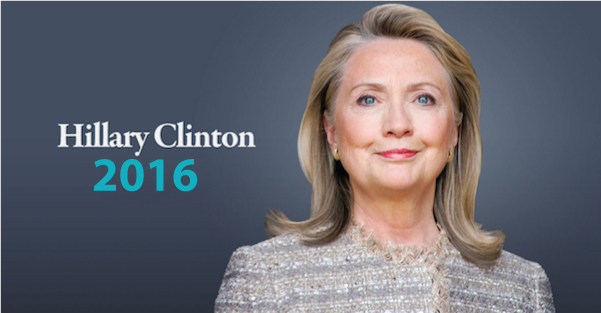
Do not interpret this post as an endorsement of Hillary. As much as I am not a fan of any of the GOP candidates so far, I am not a fan of Hillary. At the time of writing this entry, I know more about where the 3 GOP candidates stand than I do of where of where Hillary stands - and that's a big problem. Hillary is a Machiavellian Sphinx.
- - - - - -
The democrats have a big weakness - they have no fallback candidates. Elizabeth Warren does not want to run for president - her power, like Ted Kennedy's power, is to influence the debate from the Senate chamber. She is a true liberal, and has more access to the levers of power as a senator than she ever would as a presidential candidate. If she were to run against Hillary, she would only force Hillary to move to the right, instead of being able to pull Hillary to the left, as she could from the Senate floor.
Next comes Bernie Sanders. I respect him because he's a true, honest liberal. He will likely run for president, even though he can't win. The taint of the "Liberal" brush has made it impossible for him to capture any of the "Red States". Yet, he has ideas which must be included in the presidential debate, although he has no chance against Hillary.
But who is left in the Democratic party to challenge Hillary? If there is anyone, then who is he/she, and what does he/she stand for?
- - - - - -
Let's say that Hillary loses. Who does the Democratic party have on its bench for the 2020 run? I see no one who can capture enough Red states to make a difference. This is very important. Although demographics are favoring the left over the long term, they strongly favor the right in the short term. Gerrymandering, abuses of political powers, stacking of the courts, and other tactics will make it much harder for the left to gain power in the normal cycle of the political pendulum - and this is dangerous, as it will make the stakes even greater each election cycle, and authoritarians tend to abuse power to stay in power.
If we look at the recent problems in Ferguson, MO, we find that there is a political district whose officials are not representative of the community as a whole. A large percent of the community has been disenfranchised (made ineligible to vote) because of minor legal infractions. Even though these people have paid their time for their crimes, their rights have not been restored. Add to this, a government which is financed mostly by predatory law enforcement, and one has a pot ready to boil over.
What happens when the pot boils over? The most recent time it did, we had riots - which makes the people from the community look bad. These riots are disorganized, and do not serve much than to be a collective release of anger. This is inexcusable, as much as it is ineffective. But what would happen if these same people were to get illegal weapons and overthrow the police using selective assassinations? We could see a situation similar to that occurring in Central Europe in the 1920's - where Fascists and Communists fought in the streets, and a relatively unknown Austrian found a voice and a forum to gain power after a short stint in prison. You might have heard of his most famous book - its English title is "My Struggle".
- - - - - -
"My Struggle" is not the name most people associate with this book. They are more familiar with its German title "Mein Kampf". Years ago, I had a conversation with a friend whose political views shifted far to the right, a friend from whom I disconnected to preserve my sanity. And at that time, we both came to the conclusion that the political left decays much more quickly, as it tends to place more emphasis on the rights of the individual than the political right. The political right puts a greater emphasis on the needs of the tribe (its tribe) over that of the individual, though it uses misleading language stressing individual and collective liberty.
We've seen this problem before. Leaders (from the right) stir up hatred for selected minorities who do not have the power to fight back - and the average person follows, as a herd mentality takes over. In 1934, it was hard to believe how quickly a free Germany changed into an authoritarian state. People got tired of the political battles, and surrendered power to an authoritarian government simply to end the fighting - and instead, got war. We have that same danger in today's America - give those authoritarians power, and they will keep us poor and in forever wars. So it is extremely important for the political left to again have a strong back bench of people who know how to use the levers of power - if only to check and balance the political right.....