I'll bet that most police officers hope that all encounters go as smoothly as this one appears to have gone. Sadly, this is not the case - and we have had an incident in the news as of late, where one driver apparently pulled over to let a police car go by, and it turned into an escalated incident where the driver was arrested, placed in jail, and found dead in her jail cell.
- - - - - -
As I read about Sandra Bland's incident with the police, I was appalled that the police department didn't bother to follow proper procedures in this case. And then, seeing the video of her arrest, I was further appalled by (what appears to be) a cop who was looking for an excuse to hassle a person, simply because he had a bug up his ass.
The initial incident could have been handled with much more diplomacy, if the police officer had been properly trained in tools of easing tension and had used those tools properly. Could you imagine if someone had been with her in the car and was carrying a legal handgun, as is common in Texas? Would there have been as much a commotion about a questionable death in a jail cell had someone in the car been armed?
- - - - - -
To me, Sandra Bland's arrest and later death was a crime, but what really did happen? I can not trust the police - the video seems to indicate that the police officer was being overly aggressive, while Bland was simply trying to exercise her rights. Does any police authority have the automatic right to arrest someone without telling that person why he/she is being arrested? Something is very wrong here. And to make things even worse, she died in the jail - with the autopsy showing results that could have been caused by a death other than suicide.
Thanks to the internet, we are finding out about much more abuse of power by police forces over the past year or two. And this is a good thing. When the police and government have lost the trust of the average person, authoritarianism can't be far behind. Let's pray that I am wrong about this....
It never fails to surprise me about how little people retain from each day's news cycle. A few weeks ago, Obama's warming up towards Cuba was big news - and the "conservatives" were all chastising him for abandoning tactics which have been proven not to work. The same thing was done with Iran - and again, it was big news for a few days, and almost forgotten. We're seeing public opinion swayed by talking heads, in ways that George Orwell could only dream of....
Orwell, in "1984", presented a public speech where someone was ranting about one enemy, and in the middle of the speech the enemy changed. The former enemy was now a friend, and the former friend was now an enemy. Although this type of change isn't happening as fast as in Orwell's novel, we're already seeing this in our media. How many of us remember when our enemy was "godless" communism? And now our biggest trading partner is the People's Republic of China - governed by the Communist Party.
Although George Washington warned us against having any permanent entanglements, I don't think that he would believe how quickly the world changes in our lifetime. My father has seen Germany and Japan go from being friendly countries, to enemies, and back to being friends. And in my lifetime, I've seen the same happen with Vietnam, and am seeing it happen with Iran and Cuba.
- - - - - -
About 50 years ago, the city of Baltimore had its riots. And now, it had another round of riots. The problems are the same as they were 50 years ago - a general lack of economic opportunity. Americans will forget about this round of riots, as they have other important things in the news. But will we learn from them?
This time, we're seeing people around the world "armed" with cell phones (most of which contain the latest software) and active internet connections. Even in Iran's riots of a couple of years ago, the central government was unable to suppress all the news from getting out of the country. It couldn't suppress the news being passed along by its citizens. And the same thing happened here - the Baltimore Police could no longer cover up what triggered the riots - a "thug" whose rights were ignored by the police, and a death that couldn't be ignored.
Now, I've just used the word "thug" to describe this person. But is he as bad as the label I've attached to him? In an area as economically depressed as his section of Baltimore, over 56% of the adult male population is unemployed. Dr. Phil noted in an interview on Fox News that the people living in these poor sections of cities may have the same potential, but not the same opportunities, education, or inter-generational social pass-throughs. Was this person's rap sheet caused by a defect in this person's character, or was it caused by the environment he lived in?
- - - - - -
Two generations ago, we didn't need to worry about the problems of structural unemployment. Today, both people in the inner city and the suburbs are affected by these problems. The low end jobs which were stepping stones to greater opportunities no longer exist. Low value/High Labor cost manufacturing left the United States years ago. Computers have replaced humans in many tasks which would have provided work - the computer managed "help lines" we call are perfect examples of this. It is cheaper to have a human interface with a series of telephone menus than to reach a real, live, flesh and blood human. And society no longer provides the full and free education needed to fill the jobs of tomorrow.
Our college education system has been corrupted by government funding - instead of having our government expand access to college by building more colleges, we've seen our government increase the monies available to students in student loans. Simply adding more money to buy more education doesn't do much good - it only raised the nominal price of an education, making it much harder for both the poor and the middle class to afford college. And for those that got the student loans, they often now have onerous debt to repay, and are deferring having children. (I'm not even talking about those who took out predatory student loans issued by for-profit colleges that provided sub-standard educations - these students were screwed the day they entered school, and no one wants to fix this problem because the affected students come from the lower castes....) Since student debt can't be erased in bankruptcy, we now have a generation of Americans who will not be able to afford what will be needed from them in the future.
- - - - - -
It is very interesting is that the problems that once only afflicted the lower class are now affecting the middle class. Poverty used to be clustered in the inner city and in remote rural areas. Now, we're seeing newly poor people scattered through middle class neighborhoods. Houses are becoming derelict because of predatory lending combined with "Zombie Titles" that insulate banks from maintaining foreclosed properties - Banks are no longer foreclosing on many properties, making it impossible for borrowers to walk away from debt that they can no longer afford. Sadly, this may only be the tip of the iceberg when it comes to what the banks will be doing next to preserve their power in society....
- - - - - -
Where will we end up? I don't know. I'm afraid for our future, as we're seeing the signs of America's upcoming collapse - and we, as a whole, have a lot of questions about our society's future that need to be asked and need to be answered. So far, all our leaders are doing is pandering to us and our fears - they do nothing to deal with the real problems. And this is a great danger that we all should fear....
The above is a collective image of the 6 Baltimore police officers who have been indicted for the homicide of Freddie Gray. Although they deserve a fair trial by an unbiased jury, it was interesting to see how political pressure can be used to redress some of the issues raised by some of the disenfranchised in society.
In the followup to the riots, we saw the Baltimore D.A. take an honest look at the evidence and had no choice but to call for an indictment. Gray was not belted into his seat for his own protection. The police van made 4 stops, not 1 before reaching its final destination. And, the knife once labeled as a switchblade was perfectly legal for Gray to possess. There was enough of a stench coming from the police involved, that even the D.A. couldn't avoid seeing an apparent abuse of police power.
Recently, Dr. Phil was on Fox News, and he slipped through a comment that the talking heads didn't notice. Although the kids in the poor neighborhoods may have the same potential as those in the better neighborhoods, environmental factors may be making it impossible for them to achieve this potential. Around 4:20 (or so) in the linked video, he noted that there are fewer opportunities available for these kids, that the school systems are very different for these kids than those in the affluent suburbs, that fewer resources are available for these kids, and that their parents do not have the "societal" skills to pass on to the next generation (as Dr. Phil puts it - "generational pass throughs").
- - - - - -
I have commented before about the warehousing of excess population in our nation's prisons. I have commented before on the economy of the drug trade, and how it is one of the last "industries" available to poor people with criminal records. I have commented about how people have been turned into 3rd class citizens, and denied the right to vote after serving time in prison. And I have commented before on unequal education in our country. But what happens when these factors are not properly addressed by society - Riots.
Why does this concern me? I don't live in the inner city; I live in the suburbs. The answer is simple. We are seeing the gradual breakdown of society from the bottom up. As the segment of society for whom enough opportunity does not exist grows, the more unrest there will be. When this segment swallows up much of what was once the middle class, I am not sure of how long our democratic republic will survive. I am very afraid of an authoritarian government taking the place of the flawed system we now have.
- - - - - -
When the above 6 police officers were indicted, I found it interesting that the people in the inner city were celebrating. Only time will tell if these officers are convicted. But is this a bone being thrown to the masses to keep them quiet? I am not sure. Years ago, we saw the O.J. Simpson trial on TV. It was captivating, if only because a black defendant had enough money and resources to put up a strong defense and win against a prosecution who had virtually unlimited resources. (It helped that there was a mixed race jury hearing the case, unlike the civil trial held in the L.A. Suburbs.) And at that time, one heard the same cheering among the Black segment of America's population as if "one of ours finally won!"
Law enforcement and criminal defense are two things that differ between the better off and the worse off in our society. In the more affluent communities, police treat residents (for the most part) with respect. If someone has to go to trial, that person generally can muster up enough resources to put up an adequate defense. This is not the case in poor communities, where the police are being used to control a disenfranchised population, by arbitrarily enforcing laws. Because the poor do not have adequate resources to defend themselves in court, there is extreme pressure to plead guilty for lesser prison time. And once out of prison, many poor people are now unemployable in the traditional economy. The drug trade becomes the only business open to these people, creating a vicious cycle of crime, poverty, and hopelessness.
- - - - - -
If one doesn't believe that there isn't an arbitrary standard of justice in this country, look at the latest video by Willie Nelson and Merle Haggard. In it, you'll see an action for which white people are rarely prosecuted, but for which black people are often prosecuted. Depending on the state this video was shot, the action would be legal, be a misdemeanor, or even be a felony.
As much as I love Willie Nelson's music, his use of cannabis illustrates the double standard of justice we have for black and white people in this country. The police have caught him and his entourage with cannabis - and he has never (from what I can tell) spent a day in jail. Can you say this about black people who have been arrested for possession/sale of the same substance?
To me, it's about time that we end the so-called "War on Drugs" and begin reinvesting in the inner city (and its residents). If we don't, are we willing to risk losing the freedoms we have left to a future authoritarian government, just to keep the disenfranchised under control?
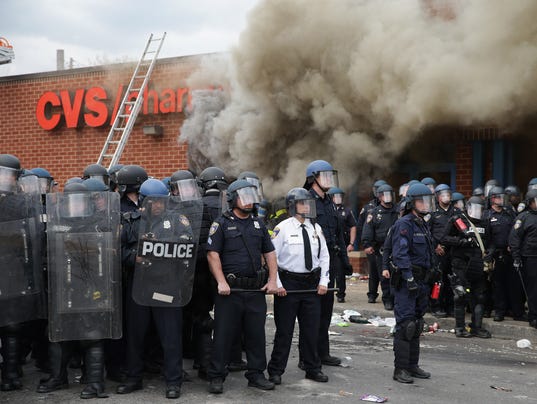
This image makes it seem like the Baltimore police had the situation under control. However, given 4/27's news reporting on both Fox and MSNBC, this would be the furthest thing from the truth.
Normally, I lean left of center (based on today's politics) when interpreting affairs of the day.When it comes to riots, I have no problems with police being able to "shoot to kill". "Why?" you may ask... To me, the answer is simple - a riot is like a quick moving cancer. If it is not put down quickly, a community gets labeled as a bad place to make an investment. And, as a result, there is a loss of jobs which can force the community into an economic death.
Sadly, the fact that riots are taking place are indicative of a bigger social problem. We have an excess supply of people who are willing to work, but can not find gainful work. We have draconian laws (especially in regard to recreational substances) whose net effect is to disenfranchise large segments of the population, to warehouse them where they can't compete for jobs against a blissfully unaware but shrinking middle class, and to function as a tool to keep the lower economic classes in check.
If we look at the people in places like inner-city Baltimore, we see poor people who have poor educations, who will not be able to qualify for the jobs of tomorrow. They are frustrated, and do not have the ability to articulate their complaints against the larger society. Strangely enough, Fox had a reporter on the ground, interviewing one of the locals in front of the police, while MSNBC only had talking heads in the studio. But the message was clear, no matter which side of the political aisle you were on - the people in inner-city Baltimore are tired of living in conditions of little hope.
Watching the Fox interview of the unnamed Baltimore local, I noticed that the local mentioned that he just got out of prison on a trumped up drug charge, where the policeman planted the evidence that was used to convict him. In the past, I'd be inclined to think that this would be someone lying to save face. However, with these incidents (and others) on file, I'm not so certain we can put the word of the police above the average citizen any more:
Can we assume that the police are telling the truth? Not anymore. Yet, I believe that most of the police are getting a bad reputation from these "bad eggs", and from policies meant to detect crimes, even when no crimes have been committed.
Let's assume that this unnamed Baltimore local's statement is true. Then this is the tip of a very nasty iceberg. The people we've entrusted the duty to protect us have become part of the problem. In an article on where Baltimore's police went wrong, the author notes that dealing drugs is the only "industry" left in the inner city - and that our current drug laws are creating a police force that no longer polices neighborhoods to keep them safe, but instead, becomes a tool used to keep the poor and disenfranchised in line, and afraid to challenge the corrupt status quo.
Most policemen starting out are good people who are put under a lot of stress every day. However, our elected leaders set policies that often demand that the police meet quotas to show that crime is being reduced - and our police oblige them, out of fear that they will become victims of politics. Instead of being the trusted members of the community that one could count on to find out who is committing crimes, they become the distrusted outsiders responsible for keeping a sector of society out of public sight.
The big question is - how long will it be before the lower classes in American society rebel, as the French did in their 1784 revolution? I have no idea, but I hope that we can humanely fix the problem with the disenfranchised poor before they find a way to create a successful revolution of their own....
Alcatraz, The Rock.... This is where we once placed our most hardened criminals. But what happens today? We have "supermax" facilities which have never been escaped from, and yet congress prefers to keep people captured in Afghanistan at GITMO (Guantanamo Bay) instead of a more humane site on the mainland. This political hot potato will be around until 2017, at best, and it is something I may address at a future date.
- - - - - -
Today's entry starts with a crime that happened almost 2 decades ago. And I'm not sure if justice could have been served, given America's feelings about mental illness, crime, and punishment.
In the mid 1990's two of my neighbors were having an ongoing feud. One of these neighbors was a retired barber, and the other was a kindergarten teacher. In America, we attach a stigma to people who suffer from mild to severe mental illness. They are told to "man up" and deal with the illness, preferably without appropriate medicines. The barber had no reality check in his life, no one to talk to, and likely had a mild depression that quickly progressed to a severe depression early in his retirement. The teacher, on the other hand, was well connected, saw reality for what it was, and was afraid of the neighbor below her.
At the time, I don't even think that their feud was on my radar. My wife was still alive, and I was seeing her gradual decline cause by the cancer which would take her life. But I was quickly awakened to the problem one weekend in January, 1996, when I saw police cars in my driveway, and police tape tied to the antenna of my car. As I remember the story (and time has made my memories much more fuzzy than I'd like) Neighbor B shot neighbor D in the chest with one of his shotguns. He went back to his apartment, and saw neighbor A on the way. She asked him "what happened?" and he said "go upstairs." Neighbor did so, and found neighbor D on the floor, saying her last words before she died.... Over the next few hours, the police were there, and traffic in my co-op's parking was paralyzed due to the presence of police cars, county mortician, etc. blocking access to the rest of the parking lot.
Over the years, I often wondered what happened to this fellow. What was his life like afterwards? If this crime had occurred in Europe, he'd have served time, but gotten the mental health treatment he obviously needed - and maybe have gotten released once he was no longer a danger to society. However, this crime occurred in America, a country which believes in harsher punishment than many of our peer nations. After he was convicted, he was incarcerated in a facility roughly 400 miles away from home (making it very hard for any family members, if any, to visit), and spent the rest of his life behind bars.
Was this justice? I think it all depends on your viewpoint. If you were of the victim's family, you might feel that the fellow deserved it. If you were of the criminal's family, you might feel very sad, but believe a softer sentence would be appropriate. And if you were an interested observer like me, you might be unsure - as this was a preventable situation.
- - - - - -
The night I started writing this entry, I had to deal with a problem concerning the same two apartments. And once I connected the dots between the apartments, it triggered the memories that caused me to write this entry. However, this time, neighbor D2 was harassing neighbor B2. Neighbor D2 is not a native born American (nor was the original neighbor B). And both seem to be/have been isolated from the rest of their communities. I'd bet that neighbor D2 also is dealing with a psychological disorder, based on his actions toward his neighbor. I'm hoping that if things start to escalate further, that the co-op board can help prevent such extreme results....
What can we do to protect someone from an unbalanced neighbor? Can we do something without violating someone's civil rights? I have no idea. But I know that justice isn't being served as long as we, as a society, allow situations like these to escalate without proper intervention....
One of the problems we have in our society is that we have incarcerated people needlessly for low level drug crimes, causing us to spend over $90,000,000,000/year in keeping 0.5% of the USA's population locked up, and preventing them from looking for well paid (legal) work due to the fact that these people now have criminal records.
Over the past few months, I have had a correspondence with a special-ed teacher in a New Jersey school district which is having trouble with an autistic child (19 years old) who is biting others, and is a danger to the school - but who is not being removed, due to the school's principal seeing this child as a source of school funding. The situation is very bad, and the staff is helpless in getting the problems fixed.
So, I made the following suggestion:
I wonder if there isn't another way this problem can be attacked. The kid is 19, and he assaults people. What if someone made a formal complaint to the police, for assault. That would blow up things, and the administration might be forced to keep the kid out of school for the safety of others.... Also - what about notifying the parents of the other children that the biter could be putting their kids at risk? There are so many ways to blow up this situation before serious, permanent damage is done by this kid.....
And my friend responded:
I appreciate your ideas but with an administration (superintendent, principal & supervisor) who all came from a place where a whole class of 5 boys could be this bad and most classes had at least one of these (according to the gym teacher who also is from that school) I doubt much can be done. They did temporarily "exclude" (not expel) another kid, younger, who drank from the toilet and put his feces all over the walls in the bathroom. He also threw things at other kids (one of whom could get a detached retina easily as he is going blind anyway and has other medical issues). Our consulting psychiatrist did an eval now the parents must do their own before he is allowed to come back. Our shrink, who is terrific, said the kid needs meds before interacting with others but mom is opposed. At least that kid is out. Now -- this is where I said we have little hope of anything changing for the biter kid.... this poop smearing kid was in my friend (R)'s room. She is an outstanding teacher. She never, ever raises her voice. Every teacher knows she is wonderful and non assertive. When she got poop smear kid who is classified as 'autistic' put into her class and then he acted up she asked the principal why the kid was in her class and not the class (same ages) of all autistic. Well, anorexic principal didn't like being asked that I guess so when R was "observed and evaluated" the principal wrote lies, such as R didn't greet this monster kid when he arrived, didn't talk to him at all, etc. So she went to the union rep and it turns out the principal only admitted she was in the class 15 minutes not the 20 that is required for an observation so the whole thing had to be discarded !!! The union rep is convinced the ridiculous eval was due to R asking a legit question. Most of us who have been at the school 5 years and did NOT come from the principal's old school know that the reason this monster didn't get put in the autistic class was because that class is taught by the Japanese lady (aka 'golden girl') who, of course, taught with the principal in the old school district !!!! That teacher is never short of aides, like the rest of us are at times due to absenteeism. She gets first crack at substitutes, etc.
Many of our student's parents are just glad their kids are someplace and if the admin could figure out who notified these parents our jobs would be gone or we would be treated unfairly (like my pal R). Years ago in our adjacent school for the emotionally disturbed, a teacher did call the police and he was transferred to another school. Apparently the kids can injure us, maim us, grope us, etc and we have no alternative except a CPI (crisis prevention intervention) blocking action which does not work (according to the course we had to take) IF the student is bigger (the 19 year old is taller than me and all the female staff). I think we are stuck with having to put up with it because it is "special ed" -- I am definitely going to look for another job in April when jobs are posted, although I am realistic about finding a district that will hire someone over 50 --- it was hard enough when I was over 40 and looking and now I am "more expensive" since they will believe I won't take a starting salary. (I would take less but not starting).
P.S.: When "mentally challenged" people (usually men) get away with crimes, including murder, do you think anyone is going to do anything about this kid?
And this got me thinking.... What if we repurposed the prisons, so that they can hold "children" like this 19 year old "student" and remove him from society, so that he won't do any harm to innocent people? They can be made very humane, provide lots of employment, and do a real good for people.
If we took ALL the money we'd save on incarceration and spend it on health care for the "mentally challenged", we'd free the low level drug users to earn more money and pay more in taxes. Wouldn't this be a net gain for society? Of course, corporations could have their current (and in my opinion, now foolish) drug tests for new employees, but then with most drugs being legal, I'd expect to see employee retention based on performance and not on what substances they consume outside of the office. (Do we really need to arrest people like Willie Nelson for inhaling the vapors of his "medicine"? I'm pretty sure that his productivity (as well as other artists) is enhanced and not negated by cannabis.) We'd still have our laws against driving, using heavy equipment, or other high risk tasks, while under the influence of any drugs - so that abusers could be treated appropriately under the law.
In previous versions of my thought experiments on this topic, I never figured out a way to provide jobs in the areas that would lose them has my proposals taken effect. However, the answer was staring me in the face - just put a different class of people in "prisons" who really do need to be isolated from society, and keep the same players in the game. Yes, the court system will be affected. Police will not get as much overtime as they've been accustomed to. But in the whole, we'd be all be better off - including these "children" who will never likely be able to function in society as independent adults.....