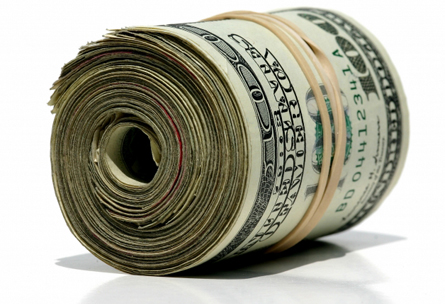
If anyone thinks that this election is about anything other than money, then I have a nice bridge in Brooklyn to sell you. Both major party candidates are in it for the money, and both represent what is wrong about the system.
- - - - - -
Let's start with Donald Trump. He represents what is most objectionable about the current GOP. He acknowledges that he has bought and sold politicians in the past. Reputable news sources state that his business deals have served to make himself rich at the expense of others - including his business partners. And he suffers no embarrassment from making almost everything he says a lie - appealing to potential voters' more primitive brain functions, instead of their intellect. When he says that he loves ignorant people - he means it!
We have a large number of people who have been lied to for years. The political elite from the GOP has ignored the needs of the common people. They have told us that cutting taxes will result in greater tax revenue as well as more jobs available to the common person - and we know this to be false (anecdotally) from recent experience. (I'm not saying this can not be true, but we had no proof of where we were on the Laffer Curve, and whether our tax rates were high enough to slow down the economy.) The GOP has not changed its tune, and the public has seen work move overseas or get automated out of existence. To the GOP elite, the common people are serfs for whom they have no responsibility, and we have suffered because of this attitude.
- - - - - -
Before one gets to thinking that Hillary Clinton is that great, one has to examine her record. Even though she has advocated some good things (such as healthcare reform), she is equally corrupt. For example, in this election cycle, she has changed her tune on TPP (Trans Pacific Partnership - a trade deal which could negatively affect American employment) from being for it to being against it, only to get the votes that might be cast by Bernie Sanders supporters. Most people believe that once she is elected, she will change her tune on TPP without any significant changes being made to the deal. In short, she will betray her supporters in order to get power.
What would Hillary do when she gets power? Well, she has sucked on the teat of Wall Street for years. It is no coincidence that the Clinton Family wealth has gone from a book value of almost zero (when Bill Clinton left office, as noted by the deal that gave him a mortgage on their Chappaqua, NY house) to over $100 million today (as estimated by the news outlets). Does anyone think that she would support policies that benefit the common person over the lords of Wall Street? I think not.
- - - - - -
So where does this leave us? Do we vote for a revolution led by one of the people who gained the most from exploiting a corrupt system, and has never had to run a system of any size by himself? Or, do we vote to put a competent, but corrupt leader in charge - and defer the revolution to another day. In the end, it's all about "the Benjamins" (slang for $100 bills). Do we want to run the economic risk posed by putting a potentially incompetent leader in charge? Or, do we accept the corruption we know from a competent leader? Either way we're screwed. The only difference is - how bad it may be for us.
Nobody really believed it would happen. But the "Brexit" vote proved eveyone on Wall Street wrong. Once the vote count was announced, the stock market dropped over 600 points. Wall Street hates uncertainty, and the "Brexit" creates great uncertainty for all of us.
- - - - - -
The initial analysis of Britain's vote found that older people tended to vote to leave the EU, while the younger set voted to stay in the EU. The old folks will not have to live with the results of their decision as long as their children and grandchildren. But this is the last gasp of a generation who has been betrayed by its political elites, and who doesn't much care what happens after they cast their vote of "No Confidence" in the system.
Will Brexit really happen? Although it looks like it will, this was a non-binding referendum. Once the costs for leaving the EU are known, I'm not sure if the Brits won't be given a second chance to vote on this issue - as a way of asking: "Do you really want this divorce? Your husband may have had an outside lover, but he has always been there for you when you needed him - and you needed him a lot."
- - - - - -
The same forces that have affected Britain are affecting the United States (and many other Western countries). Old folk are feeling betrayed by their elites, and no one is addressing structural unemployment. The West is being tasked to absorb millions of immigrants from failed countries, and are facing serious challenges in preserving its cultures in the face of poorly educated people who have different cultural values, and who are not easily absorbed into the work force.
Donald Trump is using this issue as a springboard to gain power. However, he is not a trustworthy person. When the Brexit vote result was announced, Trump took this to be an opportunity to promote one of his golf courses there. Do you think he wouldn't use the presidency to line his pickets? I wouldn't trust him to give me the correct time!
- - - - - -
To beat Trump, Hillary has to play to her strengths. But she has to pay attention to Bernie Sanders' platform. Why? She needs the votes of America's youth. She may have to lie to them (as she has done to many people in the past), but she has to get their votes, lest they get totally screwed by a Trump presidency.
There is one problem with the above approach - No one trusts Hillary. So she will need to pick someone who can be believed. But she can't pick Bernie - it would destroy his reputation and not help hers. But Elizabeth Warren may be a good choice, if she feels she should risk Wall Street's wrath to get elected.
Is Hillary able to work with Bernie for the greater good? Can Bernie accept that his base must be lied to convincingly to get them to choose the lesser of evils and vote for Hillary? Does Bernie have enough smarts to be a smart loser, and extract as much from Hillary as possible for him to be a leader in one of the opposition wings against Trump? One thing I know. I don't want my dad's generation making decisions that will harm my children's generation - and a vote for Trump will harm my children and grandchildren's generations, and maybe more after that....
When I wrote the following rambling missive to a friend, I didn't realize how well it could work as a blog post. Thinking about this letter (and my friend's unpublished response), I realize that I am a Jeffersonian at heart, while my friend is a Hamiltonian. In short, I believe in the will of the people, although I believe that it must occasionally be checked and balanced. My friend sees the elite as a needed safeguard against the rabble running amok.
For the most part, our views are two sides of the same coin - both of recognize the public's need to have a say in their own affairs, but we both recognize the need for a buffer to keep the common person from destroying the society in which he lives. And both of us have been lucky enough to avoid the encumbrances that would make us slaves to the society in which we live, instead of controlling our own destinies to a large degree.
Right now, I see the Trump and Sanders campaigns having their successes rooted in the general belief that the public is mad as hell and isn't going to take it any more. A Trump or Clinton win would result in a one term presidency - and would leave the body politic much more unstable than we can afford at this time in history. Yet, I like instability (to some degree) as I like to see the body politic refreshed by healthy blood - something we haven't seen in a while.
So I hope you enjoy today's missive, in the form of rambling thoughts I've written to a friend to provoke conversation....
If I were going to do a War Of The Worlds story today, I'd make the "aliens" look more like us, so that the alien invasion would not be that of a faceless enemy, but of an enemy that lives with us. (This reminds me of a movie that Roddy Piper made - "They Live.") The story would be more of the dilemmas a space faring civilization faces when encountering a "sort of" sentient species, and then the ultimate realization that this planet is too toxic for that species to inhabit - leaving the formerly colonized to think that they had the upper hand in their own right. Of course, one could throw a lot of social metaphors into the story to give the story more gravitas than it deserves, and to score higher ratings from the critics.
The problem with a lot of mass media these days is that it has been dumbed down for a lot of Americans to consume. For example, how many shows will they make about antique and pawn shops, along with the people who run and supply them? How many shows can they make about dwarfs and their families? How many shows can they make of "unusual" families? Of course, I'm biased. I feel that narrowcasting has allowed a significant portion of the American public to avoid exposure to ideas to which they feel uncomfortable.
I think the problem starts in the schools and in the homes. Both liberals and conservatives can make good arguments about the problems in educating our children. But I also think we're seeing signs of structural unemployment which can't be ignored. Low end jobs are being outsourced to low wage places, leaving America to increase the size of its social safety net, lest we have major social unrest. Couple that with middle to high end jobs now gradually being replaced by computer functions, and we may be looking at a situation (which could become worldwide) where there are more people than jobs. How can a society cope?
Before you think that my idea of people outnumbering available jobs is a problem that could result in a radical solution, think of this. Before the Black Plague, "serfs" (I could equate them to newly freed slaves becoming tenant farmers) had no social power, owed most of their production to the manors, and could afford to take no chances with what they grew. There was always another serf to take his place. The plague took away all that excess labor that the manoral economy depended on, took away many of the lords and ladies, and left the remaining labor with the upper hand. They started to grow a wider range of crops, ate better, and were part of an economy that started to develop labor saving inventions because there were more jobs than labor. What could happen in America with roughly one gun in circulation for each of its citizens, if our elites don't address the problems of an economy where there are more jobs than people? Any slight event could radically destabilize things, resulting in great population loss before a new stable state is achieved.
So we go back to the schools and the homes. Religious fundamentalism has shown itself to be a plague on mankind. We have home schooled students who can't prove they know enough to enter trade schools. In fact, many of them can't do the math required for these schools, because their parents decreed that the bible contains everything the child needs to learn. We're already seeing what happens to some states when these clowns get to power - education gets shafted, in one case, the cutbacks meant that there was no local school available for the children of one town. (I wish I remembered the full details of this situation - I think it was in Kansas, but I'm not sure.) I shouldn't pin the blame on religious fundamentalism alone. We've seen the same neglect for our school systems and families in non religious areas of the country. We're seeing an America divided on Rural vs. Urban lines, and the Rural populations are winning for now. They are making the mistake that the solutions that worked 50-75 years ago, when the US was at its greatest level of prosperity vs. the world, are still valid today. Simply praying to god a bit more, and resisting social change (acceptance of the GLBT population as having equal rights), will not solve their problems. Something more is needed from both Rural and Urban populations....
We now have ready made scapegoats for people like Trump to exploit. Before you say I'm about to go into a diatribe against "the Donald", reflect on this - he did bring issues into the political conversation that the political elite would rather not address - albeit in an inelegant, crude way. I'd rather see him as president than Cruz. A vote for Trump is the hard core Republican's way of giving a vote of "No Confidence" to the GOP and its candidates. Sanders is the equivalent from the hard core Democrat's side of things, especially when it's a vote against Hillary Clinton. Although Sanders has not fleshed out his ideas that well, he might be the least dangerous person to elect because a GOP dominated legislature will block his every action.
Both political parties have their own reasons for keeping the insurgents from taking power. But it's harder to see the benefits of the insurgents gaining power. If Trump were to be elected, he'd be a wild card, a joker waiting to do something that would trigger impeachment and conviction - removal from office. It would also mean that the GOP would be able to get rid of its extremist elements and could produce a party ready to govern again. If Sanders were to be elected, it would give the Democrats a reason to stop a continued slide to the political right, and renew its position as a moderate leftist party again. And with both Trump and Sanders, I expect that they would have their reasons to deal with Wall Street and the corrupting influence of its money and power. Trump, to remove power from his enemies. Sanders, to clean up a system which caused the mess we are in....
As I noted, this was the start of a conversation that has lasted several sets of email exchanges so far. The ideas are not well formed yet, but they touch on problems that have been long ignored by our elites. I only wonder whether our leaders will bother to do their job, or continue to push America towards the decline of its empire....
Bernie Sanders - the "Independent" senator from Vermont who caucuses with the Democrats. The big question for many is - Is his candidacy for real, or is he, like Elizabeth Warren from the sides, trying to pull Hillary Clinton to the left?
- - - - - -
There is one key element in play that benefits both Sanders and the Democratic party. By running on the Democratic ticket, he prevents a three way race (GOP Wingnut, Hillary Clinton, and Bernie Sanders as an independent) that would give the presidency to the GOP. Since Bernie plays nice with the Democrats (look at his debates with Hillary for example), the Democrats are more than happy to let him play in their sandbox. Even if he loses to Hillary, he has done his job - keeping the Democratic contender for the office of the president from going too far to the right to win votes.
However, Bernie's candidacy throws a monkey wrench into the expected coronation of Hillary Clinton as the Democratic Party's candidate. Debbie Wasserman Schultz is an avowed Hillary supporter, and has gamed the Democratic Party debate schedule to prevent Bernie from getting name recognition. And yet, he may just yet win both the Iowa caucuses and the New Hampshire primary. Can you imagine if Hillary is doomed to lose before the real campaign starts?
- - - - - -
As I see it, the important differences between Hillary's platform and Bernie's platform focuses on two areas: Regulation of the Banking Industry and Healthcare. Hillary has said that Wall Street needs greater regulation, but falls short of a restoration of Glass-Steagall. She is also pragmatic, and says that any attempt to change the healthcare system, Obamacare, with a Republican congress might make things worse. On the other hand Bernie says that restoring Glass-Steagall and Medicare for All is absolutely needed.
Bernie has yet to issue a detailed plan on how America can afford "Medicare for All", but his logic does make sense. A recent estimate from people unconnected with Bernie's campaign estimates that the average family savings under his plan would roughly be between $500-$1,800/year. Given the GOP and its willingness to repeal Obamacare, does Bernie really think that he could implement his plan?
However, I think that the reregulation of Wall Street is possible, as even the wingnuts of the GOP right wing hate the banking industry. But could Bernie unite enough people to dislodge some of Wall Street's corrupting influence on Washington politics? I'm not so sure of this.
- - - - - -
In the past, I have noted that both Sanders' and Trump's candidacies have been propelled by the same fuel - the ruling elite of both parties has betrayed the public, and that public is mad as hell and won't take it any more. At this point of time, I still predict a November election with Trump and Sanders being their parties' candidates. And it will be very interesting.
But the big question is - Does Bernie have a real chance to win? And if so, will the Democrats (other than Debbie Wasserman Schultz) try to scuttle him before he wins too many delegates?
OK - I'm not too original today.... But the recent sale of AOL to Verizon made me think of Wall Street, and how it has a nasty habit of creating deals that squander more wealth than those deals create.
- - - - - -
Let's look at the case of AOL. Years ago, it dominated the dial-up internet market. I'm pretty sure most of my readers remember how ubiquitous AOL software CDs were in the 1990's and early 2000's. One couldn't help but get several of these disks every week - and AOL made a lot of money way back when.
At the peak of the market, AOL bought Time Warner. For AOL stockholders, this was a great deal - it gave them real long term value for the stocks they held. However, for Time Warner stockholders, one has to ask - what were these idiots thinking? Yet, no one blamed the advisors at the investment banks (organizations such as Merrill Lynch, Morgan Stanley, et.al.) for selling a questionable bill of goods to Time Warner stockholders - many of whom saw the value of their assets plummet. However, the investment bankers made out like the bandits they were. Eventually, the combined AOL Time Warner got smart - and unloaded AOL. Of course, these same investment bankers made even more money for handling the transaction. Was there any real value generated in either of these two transactions? No. But the investment bankers extracted their share of wealth - and passed it along to their upper managers.
Today, as I started writing this entry, Verizon has just announced that it was buying AOL - in part because of its mobile content. It seems like the same story, but different characters. In this case, AOL brings to the table some technology and some media that Verizon claims to need for its efforts to get people consuming media via cell phones. Does anyone really believe that AOL, with its history, has much to contribute to Verizon?
- - - - - -
Over the years, we've seen many deals orchestrated by Wall Street that made no sense other than to line its coffers. The deals get made, and then a decade or so later, they get unmade. The only deals that ever make sense are those that allow for consolidation in shrinking markets, or for those which allow for expansion in growing markets. Yet, the vast majority of deals do not meet either of these two conditions.
A few years ago, a major Wall Street financial services firm (with a bank charter) ended up merging with one of its major competitors. Upper management claimed that value would be added by "synergy savings". (Read: Layoffs). The two firms merged just before the 2008 financial panic, and made sure that its layoffs were made on time, so that the firm could meet its financial numbers. However, a goodly number of the tasks required to integrate the two firms were left undone - and this created an unwieldy infrastructure which cost the firm more money than if they had missed their numbers for a quarter. (In 2008-2009, no one was hitting their financial targets.) Several years later, the same firm had expenses 120% of that of its peer group - and the only option it had left to make its numbers was layoffs.
Would this organization have been better off had it not merged two competitors? I don't know. But neither organization would have been wasting time trying to integrate two very different firms, and neither organization would have been number one in its market - leaving room for either of them to steal each other's market share, instead of having to perform the harder task of protecting a number one market share. In short, being at the top of the heap limits the organization's room to grow, while being number two, three, or four allows for greater competition, greater innovation, and greater returns to stockholders.
- - - - - -
I'm not saying that all deals are bad. Some deals can be quite good, if performed with the right partner. For example, it was a big mistake for Daimler-Benz to purchase Chrysler. They had no way to integrate corporate cultures, and there was no "synergy" (I hate that word), as Chrysler had nothing to offer Daimler-Benz. Eventually, Chrysler ended up in the hands of Fiat.
Now, Fiat had an interesting history of its own. GM had the option to purchase Fiat, and bailed out - costing the firm a lot of money. Fiat found a way to become financially strong, and saw an opportunity in buying Chrysler that Daimler-Benz didn't have. For Fiat, Chrysler became a springboard into the United States that Daimler-Benz didn't need. Some of Fiat's technology made it into Chrysler cars (e.g. the current Dodge Dart), and some of Chrysler's product line became available to Fiat (e.g. the Jeep). Here was a merger that could work over time.
- - - - - -
Why is this important?
Wall Street will be playing a major role in next year's presidential elections, as it will be throwing money at all the major candidates and expecting a return on its investments. The investment banks will want to keep making value consuming deals, and expect the taxpayers to subsidize their losses.
Can we afford to allow them to get away with it anymore? I doubt it.....