Showing posts with label Richard Nixon. Show all posts

Wednesday, September 2, 2015

Thoughts on the Clown and Kiddy Clown debates


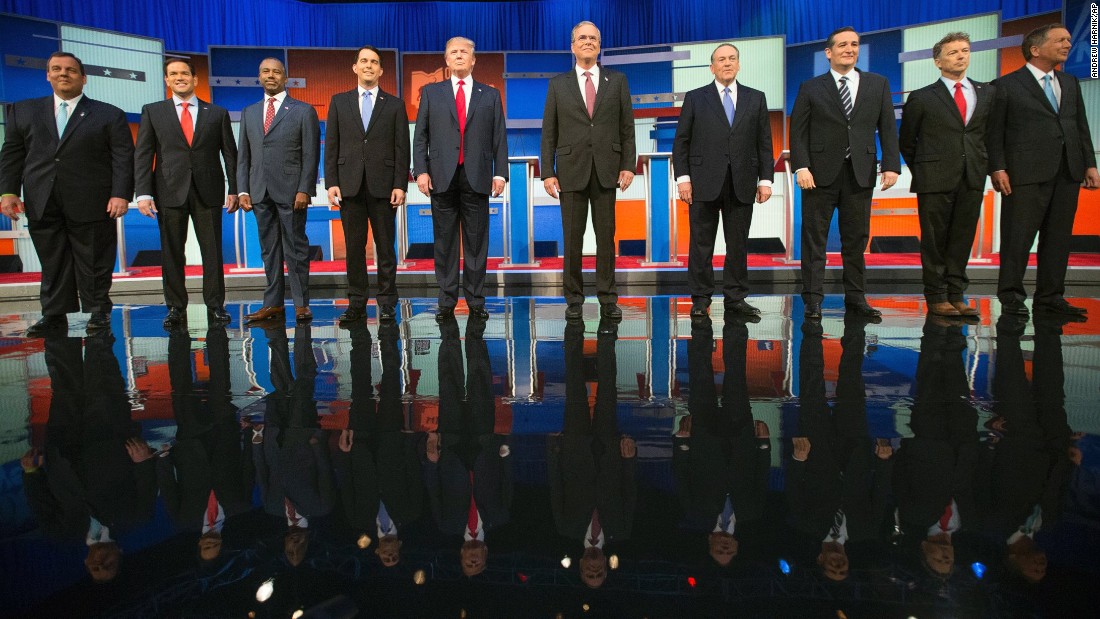
I don't think that most people realized what happened when Fox limited the "adult clown debate" to the top 10 contenders for the GOP nomination. By creating two levels of debates, they marked several serious contenders for the nomination as irrelevant before the bulk of campaigning had even started.  Worse yet, the GOP delegated the task of culling out weak candidates to an interested, non neutral organization whose business should be reporting the news (with appropriate spin) and not being involved in the process of making the news itself.


- - - - - -

Currently, the joker in the deck is Donald Trump.  He has the ability to foul up the GOP's chances for victory, as he can set the tone for the party well after the campaigns would normally be tacking back to middle ground to attract the interest of independent voters. Trump's success is easy to explain - he has gathered the interest of voters who believe that the 2 mainstream political parties no longer listen to the true wishes of the people. And in many ways he is right.

The way I view Trump's election bid is simple - it started out as a great publicity gimmick to promote Trump's other ventures.  One problem - he didn't expect to succeed as well as he has done so far, and he's now caught in his own trap - he must make a serious run for an office that I don't think he wants to hold. He is now caught by his own words - he has to break the logjam that the two party system has made in Washington for his reputation to be preserved. So he has to learn how to tone down the BS and Bluster, and start saying things with real meaning.  This is going to be hard for the greatest snake oil salesman alive in this country today.


- - - - - -

If Trump ends up making a 3rd party run for the presidency, I expect that he will not get on the ballot in all 50 states.  This might not be as big a problem as it sounds.  As long as we use the electoral college to perform the real election of the president, it is possible for a person to win the office of POTUS with the votes from a handful of states.

This brings us to examining previous 3rd party runs for POTUS.  The most recent run that had any chance of success was H. Ross Perot's run - and he failed miserably.  However, is we look back to the election of 1912, all hell broke loose when Teddy Roosevelt ran against Taft and Wilson.  (And there were 2 other viable candidates, one of them being the Socialist, Eugene V. Debs.)  Although Taft and Roosevelt had more votes than Wilson, the disunity in the "Republican Tribe" gave the election to the Democrats.  And this is what the kingmakers in the GOP fear most.


- - - - - -

As for me, I like what I've seen so far.  Trump is exposing the hatreds at the core of the GOP base, and the elders running the party machine don't like it.  Trump's candidacy is going to bring a breath of needed fresh air to the GOP - and may finally force its leaders to rectify the mistake made when it chose the "Southern Strategy" of appealing to religious fundamentalists and racists during Nixon's reign.  

I hope this happens.  It would be nice to see a conservative party that only focuses on economic conservatism for a change....


Wednesday, August 12, 2015

It starts and ends with a Pariah


About a year ago, I was talking with one of my friends, and she told me of an experience her sister had with a famous TV personality. At that time, I said that I would be waiting for more evidence to come out - and it did.

- - - - - -

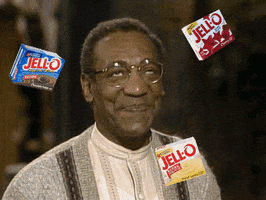
This week, if Bill Cosby's reputation isn't shot, it soon will be, given everything being published in the media.  Oh, how the mighty hath fallen!  When the talk about Cosby mentions him giving pills to women, and the President (in no uncertain terms) defines what rape is, I do not expect that this man will be able to rescue his reputation.  But stranger things have happened before.

Years ago, 3 term Mayor Marion Barry of Washington, DC was convicted on drug charges, and after serving his time, was elected to a 4th term as mayor. It is amazing how many people with criminal records have been elected to public office - in the United States, and elsewhere. It's as if we expect our politicians to be criminals, and don't demand much more from them.

In many ways, we get what we deserve - we often vote out of tribal loyalty, and then complain when things don't change.  I will never vote a straight party line ticket. But I will vote against a party line.  Let's say that I am pro choice.  In this case, I would not automatically rule out a GOP candidate who has shown himself to be pro-choice.  And if I were pro-life, I'd consider a Democrat who is pro-life.  In short, I don't let the two-party system define me, and I hope that it defines the choices of fewer people in the long run.

- - - - - -

Why is it that the two party has worked so well for so long, and then failed so miserably in recent times?  In the past, both major parties had an equal balance between conservatives and liberals - in regard to social agenda.  There was only a mild bias towards or against business in each party, and one that wouldn't stop people like Theodore Roosevelt from acting against the worst of business excesses.   Today, as a result of Nixon's GOP "Southern Strategy", there are fewer social liberals in the GOP , as well as fewer social conservatives in the Democratic party. This has forced the Supreme Court to be the arbiter of major social decisions - much more so today, than in the past.

In a way, the Supreme Court's role as an arbiter is a good thing.  The two political parties reflect two extremes in our society which can never be reconciled. One side believes that the social order must be maintained, no matter how unjust it is to any one individual or group.  And the other side believes that the rights of the individual (when in doubt) trumps that of the larger community.  This divide can be defined in other ways, such a slow/fast lever defining the rate of societal change. And it has been defined as a rural vs. urban divide. But with each of these definitions, very few things bind the two sides of society together.

- - - - - -

If we look at the Bush ("W") and Obama administrations, a casual observer can see the hypocrisy in both tribes.   And it's hard to get anything useful done when the leadership of the country is delegitimized by calling the person a criminal (as int he case of Bush) or an illegal alien (as in the case of Obama). Both tribes are equally responsible for this problem, as they have made anyone who makes an overture to people in the opposing party into pariahs. 

Yet, when we look back at Bush's presidency (I think he was a poor president), one finds someone more than willing to appease his party's base. Did he get much done?  Not as much as it may seem, as we (luckily) had a Democratic congress to check and balance his political instincts. (And now, the GOP can check and balance Obama's excesses.) His legacy, as I see it, will be the unrestrained and unnuanced response to terrorism, and not bothering to finance his wars properly - as we did in all of our country's other wars. (Does anyone remember WW2 war bonds?) To me, it was the Bush administration who was responsible for the unchecked loss of domestic privacy (with unwarranted searches and seizures), the unchecked use of torture (waterboarding, etc.), and the 2008 financial system "almost" collapse.  The public (and much of the GOP) is right to consider him a pariah....

- - - - - -

My question is: Who should be a pariah?  Is it just any person who commits a heinous act for which he/she should be ostracized from polite society?  Or, does tribal loyalty have a part in answering that question.  I feel that Bush was a decent man who was playing in the wrong league - and allowed a lot of bad things to happen.  Should he be a pariah?  One thing I know, I will not be watching any reruns of Bill Cosby's shows anytime soon....


Wednesday, January 14, 2015

The failures of American Society


The American Empire is in decline, and the elite does not see this for what it is - a breakdown of the ties that bind us together as Americans.

America, like much of the Western world is suffering from structural unemployment. In short, we have too many people and too few jobs to go around. Neither political party has a clue about what has to be done, and even if one did, its actions would be negated by the other party. Winning the game of politics has become much more important than serving the people.

If the problem were structural unemployment alone, we might look back to the Great Depression and develop "make work" programs such as the WPA, using the labor to rebuild our crumbling infrastructure. Sadly, this is not the case. Many of America's social problems go back to the post WW2 era, and the slow desegregation of American society. Whites did not want to have their children educated in the same schools as "colored" children, and busing began to be used to desegregate the schools. The Southern churches became a hot bed of activity on both sides of the battle.

Richard Nixon sensed that the South could be flipped from Blue to Red, and implemented the GOP's "Southern Strategy" - opposing busing at all turns, and aligning the party with fundamentalist ministries who, in the past, had no political allegiance. Within a generation, the South had flipped from Blue to Red, and the traditional mix of power in both political parties had changed for the worse. The Democrats became a party of urban liberals, while the GOP became a party of rural conservatives. No longer was there a tie in either party that held rural and urban states together.

Culturally, we have become very divided.  Jonathan Haidt identified 5 basic moral triggers that people use to judge right from wrong, and they include:
  • Harm/care: People are sensitive to suffering and have negative feelings toward those who are harmful and cruel. They value kindness and compassion.
  • Fairness/reciprocity: A history of cooperation means humans have evolved a sense of fairness and reciprocity, leading to altruistic actions.  
  • Ingroup/loyalty: People place moral value on those who do what's good for the group; are loyal to the group; and dislike disloyal members. 
  • Authority/respect: Humans tend to respect authority and tradition.
  • Purity/sanctity: The idea that we view our bodies as sacred. This idea ties into religious views about the body and human actions.
Liberals tend to care only about harm and fairness when considering whether something is moral or not, while conservatives have a more traditional moral structure, and tend to care about all five morality factors. Couple the conservative viewpoint with a belief that economic failure is a result of moral failure, and one will have problems when addressing major economic issues such as structural unemployment.

In the past, we once had common broadcast news outlets, where reporting bias had to be skewed toward the middle in order to keep a nationwide audience. Was there really much difference between CBS, NBC and ABC, save for their anchors (Cronkite, Huntley/Brinkley, and Smith)? I don't think so. Without the ability to choose narrowcasted news, the American public got a balanced idea of what was happening in the world. This is not the case today. Cable allows us to select the narrowcasted news outlets of our choice, and we are fed the pablum that our biases want to hear - be it Fox News, MSNBC, or CNN. It's much harder to see things clearly when our news outlets have been chosen because they reinforce our political biases.

Why is narrowcasted news a problem? In the past, objective news coverage from Vietnam helped cause the removal of American troops from that country and end an unneeded war. Today, with narrowcasted news, there is little pressure to check and balance what the politicians are doing - and this has allowed the Military/Business elite (that Eisenhower warned us about) to put us in a position of fighting a "forever war".

"Forever Wars" take resources away from the needed rebuilding of our country's physical infrastructure. As a result, we've seen bridges fail, water mains fail, the electric supply grid fail, among other infrastructure problems. And little is done. When Hurricane Sandy hit New York a while back, we were woefully unprepared. The rebuilding of infrastructure is costing much more than it should, as we no longer know how to build and/or repair things at a reasonable cost. 

We've evolved to having an "us/them" society. If I talk about poverty, the first thought that comes to many minds is of a poor black "welfare mother" who leeches off our system. What most people don't see is that there is just as much rural poverty as there is urban poverty. Do those poor white mothers leech any less off our system?  I doubt it.  Both urban and rural poor are doing all they can do to get by on a daily basis - but the system is stacked against them.  Strangely enough two of the best posts I've read about poverty in this country came from cracked.com, the humor site....
And the sentiment is now being echoed in mainstream websites, such as in this article appearing in slate.com.


What people aren't noticing is that poverty has now come to the supposedly "safe" suburbs. Structural unemployment has left many families in need. And now, suburban food pantries are just as busy as urban food pantries.

The business elite no longer feels that it has to be in the same boat as the workers in the firms they manage. In the past, a CEO would rarely earn more than 30x-50x the salary of the firm's average worker. Now, CEO's tend to get 300x-400x the salary of the firm's average worker. Are the CEOs any better than they used to be?  I doubt it. A while back, the firm I worked for decided to merge with one of its competitors in the worst of economies. Cost savings, in part, would be achieved by letting people go - when the odds were very much against these former workers finding work at a livable wage. Who gained? The workers? No. The Stockholders? Not in a reasonable time frame. Upper Management? Of Course! But my old firm is only one of many. A major technical firm has outsourced many of its employees, so that it achieves the flexibility of having a labor force without rights. Who gains?  Certainly not labor.  Nor do the states where this firm has located its business units.

So, is there any hope? If we go back to Jonathan Haidt's moral value structures, we also find that liberals and conservatives have a lot in common - when they can stop talking past each other. They both want to resolve the problems of society, but they are caught in webs (as I see it) of tribal loyalties. If we can begin to recognize that all the stake holders in our society have legitimate grievances, only then can we start to repair the damage caused by our dysfunctional, disconnected elites....