Showing posts with label France. Show all posts

Monday, October 23, 2023

What happens when two peoples have title to the same land?


A lot of noise is being made in regard to the war between Hamas and Israel.  Sadly, most people around the world are getting misinformation, and sound bites aimed to keep their respective ethnic groups supporting corrupt leaderships.  In the case of the current Middle East conflict, the reality on the ground is much more nuanced than most people are led to believe.

A little over 100 years ago, allied powers forced the Ottoman Empire to divest itself of lands outside of Asia Minor.  This meant that control of lands such as Lebanon and Palestine (I'm using the older meaning of this place name, and not today's meaning here) were ceded to Western powers such as France and the United Kingdom.  Unlike the Ottomans, the French and British ran these lands in a ham-fisted manner.  Neither cared much about the delicate interactions that took place between Christian, Muslim and Jew.  In some cases, the same land was promised to multiple ethnic groups as payment for a temporary peace.

After World War 2, there was pressure on the UK to divide Palestine into a Muslim and a Jewish state.  However, leaders on the Muslim side did not accept compromise, and in the late 1940's Israel had to fight for its right to be a Jewish homeland.  Muslims who stayed on their land and cut peace deals with the Jewish state to be were allowed to stay and have full rights in the Jewish state.  Sadly, the Muslims who fought against the Jewish state to be could not be allowed to return to their ancestrial lands.

Today's Palestine (which contains areas belonging to Israel, as well as the West Bank and Gaza) is not a two-state solution which has been talked about since the 1940's.  Palestinian Muslims have been herded into both the West Bank and Gaza.  This might not have been such a bad thing, if Jewish settlers hadn't turned the West Bank into a "Swiss Cheese" of a territory - what could have been a Palestinian homeland is dotted with illegal Israeli settlements due to population pressures in the Israeli state.  The Israeli state doesn't care to remove these settlements to lay the groundwork for a healthy Muslim Palestine to evolve.  The people have no political rights.  And what rights they do have are often ignored by the Israeli government for reasons of political expediency. 

To make things worse, the Palestinian Authority is corrupt, and is not trusted by the people.  In the West Bank, they selected Fatah to run a government, and things have been tolerably calm (until now).  But, in Gaza, things are much different.  This part of Palestine is run by Hamas, and hasn't held an election since it took power over 15 years ago.  Unlike Fatah, Hamas has both acted like a government AND retained its goal of the total destruction of Israel.  There is no room for Israel to compromise when its neighbor advocates for Israel's total destruction.

Palestinian Muslims say that the Jews did not have a right to come in and take their land.  But how long should a claim to land exist?  The Jews were pushed out of Palestine by the Romans.  Should their claim to a homeland be denied?  But this question got me to thinking about North America.  Europeans came to North America over 500 years ago, and displaced the native peoples.  Should we be forced out?  How should the legitimate rights of the natives to their land be dealt with?  Does might make right?  In the US, we have evolved a tolerable middle ground (tolerable for "old world" settlers, that is) that allocates "reservations" (unless that have valuable resources) to native tribes.  We have a peace based on both higher population and on superior technology.  The native tribes accept our existence on what was their lands and have found ways to live in peace with us.

A while back, a prominent US politician stated that Israel will either be an apartheid Jewish state with no rights for Palestinian Muslims, or it will be forced to become a non-religious state to survive.  Previous Israeli inaction in regard to the West Bank settlements may have made a two-state solution impossible.  But what does this mean for options which may lead to a meaningful peace?

As I see it, Hamas must be vanquished at all costs.  At the same time, Israel must work with Fatah to make the West Bank a viable, functioning Palestinian state.  Peaceful actions must be rewarded, as much as they may make Israel uncomfortable.  Violence must be crushed with extreme prejudice.  A future Palestinian state may have to be sacrifice Gaza in order to become a truly independent state.  Yet, the question of Gaza remains.  Can Israel destroy Hamas' leadership in Gaza without a scorched earth policy?  No matter what, I expect to see many innocent Gazans die because Hamas wanted to prevent a grand peace deal from becoming reality.

But what can be done?

Muslims and Jews both self-select "news" that supports their own beliefs that they alone should be in control of historical Palestine.  Outside regional forces have reinforced the views on the "Arab street" that Israel can never be up to any good.  Arab media is just as biased as American media outlets such as Fox, Newsmax, and ONN have been in the United States.  Even if one was to force the media outlets to only report objective news without biased opinions from bloviating media stars, it would take generations to undo the damage caused by information biases.

So, what do I see happening?

The Grand Deal regaring Mideast Peace has been scuttled for a while, but it will return.  The Saudis have too much at risk to allow Iran to gain more power.  The Turks (successors to the Ottomans) will try to gain influence in this region, possibly by turning itself into a peace broker.  The Iranians will continue to try to stir up trouble by supporting Hamas and Hezbollah.  But this will be a losing effort, as forces allied with the Saudis and the Turks will quietly work with Israel to defeat Iran.  Israel will get involved in a protracted ar with Hamas, keeping Gazans imprisoned in their small strip of land, as they are a danger to any land that accepts them - including a West Bank Palestinian state.  

Now, what happens to innocent Gazans?

Israel needs to clean Hamas out of Gaza.  It may need to rebuild Gaza as a Hamas free zone and pay for the rebuilding of Gazan infrastructure.  But it will not govern Gaza - this has been proven unworkable in the past.  Part of a potential peace deal might involve the temporary administration of Gaza by a third power, a transitional government and media structure geared to "teach" Gazans how to live in the modern world and demand a government that responds to their needs first.  Until then, we will have war....


Wednesday, September 9, 2015

The fear of markets, and the disciplines they enforce.


It's hard to believe that the New York Stock Exchange once looked like this.  The stock market was less regulated then, but never a place for a timid person to risk his/her money.


- - - - - -

One of the things I've said for years is that I believe in open, fair, and transparent markets. In an ideal world, these markets would be self regulating. However, powerful players love to distort markets via the use of rules, and via a lack of transparency.  In the case of the stock market, most disputes are settled via arbitration - which is often rigged in favor of the large firm by the nature of familiarity.  Precedents from one settlement are not applicable in the next case, so the large firms have an edge which is almost impossible overcome.

However, the lack of transparency affects more markets, and has an even greater effect. For example, the current practice of "Non-Standard" sizing makes it much harder for a person to "compare apples to apples" when determining the price of goods. In the case of a carton of Orange Juice, the standard 64 oz. size was shrunk by all players to 59.5 oz. - making it much harder for people to determine what the real price was.  Also, the shrunken size went less far, so the customer had to buy more containers to sate their needs for Orange Juice.  Something similar happened in the size of Tuna cans - a few years ago, the standard size was 6 oz. - now it's 5 oz.!  No one asked the consumer (in these terms) whether we wanted to pay the same money for smaller size packages, or more money for the same size packages.  If they did, the marketplace would have chastised the sellers of these goods - something they avoided by obfuscating their price hikes with package size changes.


- - - - - -

Right now, people are starting to see a crisis with student loans.  This is another example of marketplace interference creating disastrous effects.  A little over 150 years ago, it was "easy" for a person to attend some of the nation's most prestigious universities.  All they had to do was learn the "basics" - which included Latin, and other skills no longer needed in the real world - and then pay the bills for school - which weren't that expensive.  However, after World War 2, the GI Bill made it easier for students to afford college - and a college education was seen as the ticket to middle class success.  Years later, our nation's policies changed to provide poor people with grants to go to college, trying to create a more diverse student base in these schools. And then came the age of college loans - which I see as a total disaster.  Instead of increasing the supply of college seats (which would have reduced prices and increased availability), policy simply increased demand for college seats by making student loans cheap, easy to get, and with no demand that a student comes out with a salable skill.  The only effect here was to raise the price for seats in a good school.

What happened to the students?  Many got saddled by debt, studying in majors that would not prepare them for jobs in the outside world.  When a student owes money on a student loan, it is almost impossible for it to be discharged in bankruptcy.  As a result, the interest on the debt makes the student loan virtually impossible to pay off.  

But what would happen if we eliminated the Federal guarantee of payment?  What if these loans could be discharged in bankruptcy?  Well, many of the private lenders would cease lending money, marginal students would stop going to college, and colleges might be forced to lower their prices for study.  The powers that be don't want that.  The banks making a lot of these student loans would cease making loans - and making guaranteed profits.

I posed a question to a couple of people and got the same negative response - therefore I know I'm on to something....  What if (1) there were no guarantees of student loan repayment by any level of government, and (2) a student loan lender could insist that a student loan borrower major in a field likely to result in a job?  Both people said that this would be wrong - the student has a right to study what he/she wants to study.  But at whose expense?  The student is usually way too immature to make many decisions which will impact the rest of his/her life. Part of college's function in society should be more than that of a trade school - it should teach a person how to think, and how to look at life with a long term perspective.  One of these people said that if he were to take out a bank loan for a car, that the bank has no right to tell him what car to buy.  Yet, one could counter - that if a car manufacturer's finance arm offers you the loan on the car, it should have the right to tie you into buying one of their cars.

In short, the lack of a efficient market (with rules for proper debt discharging) for funding higher education has caused a crisis in higher education that also affects non-students. If a former student is saddled with too much student debt, that same person may not be able to afford getting married and having children. And if this person has children, he/she may not be able to pay enough in school taxes to educate the children - a long term risk for society.


- - - - - -

Not all problems in society can be resolved by market forces.  Other methods must be used to limit consumption of resources.  Great Britain spends about 35% of what America does on health care, and has a roughly equivalent standard of national health.  Canada spends about 50% of what America spends.  And other developed nations are in the same league. What is different?  They all recognize that health care doesn't work with a marketplace model. So, instead, they ration care in ways that Americans would consider unacceptable. Britain uses results based medicine, and when in doubt, chooses the cheapest alternative. There is a waiting line for almost everything except acute emergency care - and even then, there are rules and regulations that apply - as if one were part of a giant HMO.

I do not advocate the British or Canadian models, because they err in ways Americans would not accept.  But the German and French models have a lot to offer - if only we would examine them more closely.


- - - - - -

Americans like the idea of free express roads that take them from town to town, and city to city.  There is one big problem - the price - FREE.  This has encouraged the growth of the trucking industry over that of the railroads who pay for the upkeep of their track.  One might say that truckers pay gas taxes that should maintain the roads. But in many states, especially in the South, these gas taxes have not been raised in years, nor have they been indexed to inflation.  As a result, we're seeing part of our transportation infrastructure neglected by lack of proper funding, and now at great risk - as many structures are at the end of their life spans.

What happens when people have to pay to use a road?  People actually think - do they need to make this trip?  And this is an important question, as it reflects a market helping to shape a behavior. There is a discipline that takes place in a well functioning market.  The trick is to design a market well, regulate that market well (but minimally), and make sure that only the right things are governed by that market.... This, as I see it, is the big challenge of the 21st century.


Wednesday, January 7, 2015

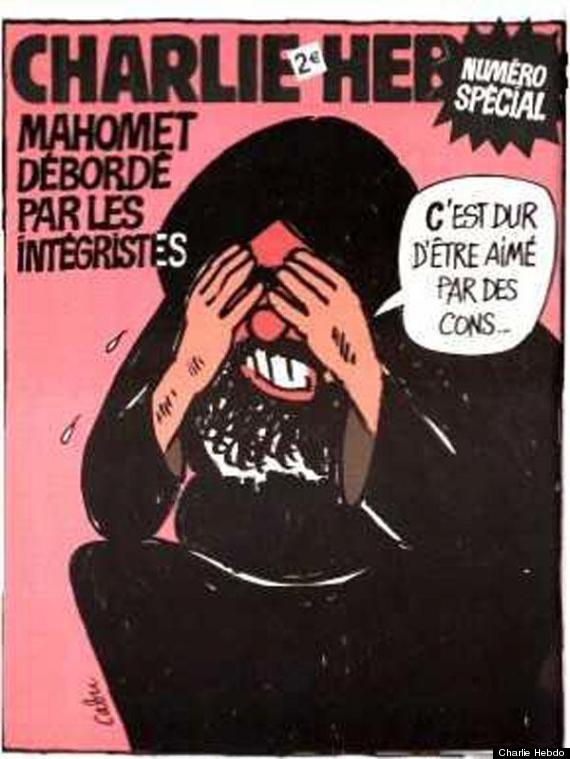
Charlie Hebdo


What is it that many devout Muslims find offensive about any visual depiction of their prophet? I can understand why they might find the pictures in Charlie Hebdo offensive, but can't they do what Christians do when Christ is depicted in an offensive way - look elsewhere?

These radical Islamists (like radical Christianists and radical Zionists) are a dangerous cancer eating away at our society. The use of terrorism to cause fear must be pushed back. But most of the mainstream media refuses to publish any of the pictures that catalyzed the deaths that just happened in France. Why? They are afraid! This is why we must insist that these pictures are published - to insure that people know why the murderers committed their crimes and why we must protect satire at all costs, as satire is the most valuable of speech protected by the 1st amendment.

Years ago, Charlie Chaplin said that he would never have made "The Great Dictator" had he known how evil Hitler was. To me, that would have been a great crime in itself. Only Chaplin could put Hitler in proper perspective - as an evil man who was out of control and wanted to rule the entire world. 

We have a choice as Americans - run and hide, or defend free speech.  Years ago, Larry Flynt was asked why he appealed an obscenity ruling against Hustler Magazine. He responded that he believed that it was important to defend obscene satire - and the Supreme Court of the United States agreed, in an 8-0 unanimous verdict. He could have given up, but he didn't. 

Yes, I find Flynt a vulgar man - unlike his then peers, Hefner (Playboy), Guccione (Penthouse), and Goldstein (Screw). But I respect him and his peers (especially Hefner) for their work to preserve the protections of the 1st amendment. And I feel that it is important that we support the right to be offensive, for if we don't support it, our freedoms will be whittled away by those who want to act as moral police....